Review of Spoleto’s Eclectic Chamber Music Program IV
By S.E. Barcus
May 27, 2026
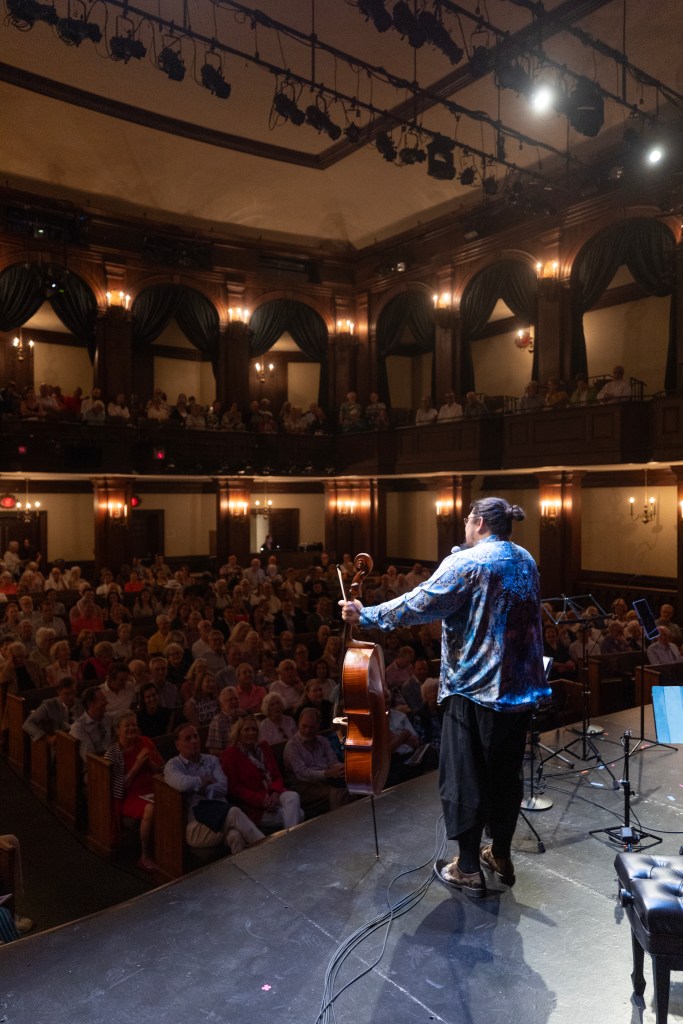
Even if you can only attend ONE of the many wonderfully curated Bank of America Chamber Music Series’ programs presented by Spoleto, DO IT. (And there are plenty to choose from – “these go to eleven”.) Spoleto’s Director of Chamber Music, Paul Wiancko, is a big lovable guy – (as well as Kronos Quartet‘s newest cellist, and composer, himself) – and he was warm and generous and funny as the “M.C.” for the May 27th afternoon Program IV, prepping us before each piece with nice anecdotes (which also conveniently allows time for the setting up of various instrument arrangements). True to the series’ M.O., the day featured a nice compliment of new, contemporary works alongside older classical ones, as well as a chance to see the Festival’s Composer-in-Residence, Allison Loggins-Hull, in action today as a flutist (and even an unprogrammed surprise piece composed by harpist, Charles Overton).
Gettin’ Gigue-y Wit It
The first piece for the Program, the coffee to wake us up, was Mark O’Connor’s F.C.’s Jig. In 1993, O’Connor wrote a Violin (… er … “Fiddle”) Concerto. Wiancko tells us that the composer then “plucked” out this nugget for a separate violin/viola duet chamber piece. “Now — we thought ‘F.C.’ was some beloved partner, or pet, or something…?” muses Mr. Wiancko. “… It turns out just stands for ‘Fiddle Concerto!’”
A definite, bouncy jig, but with decidedly Western classical influence, where lively Irish countrysides can intermittently have notes bent into quick haunting dissonances here, or slower pensive moments there – always to spring right back up quicker than you can say ‘Lord of the Dance’.
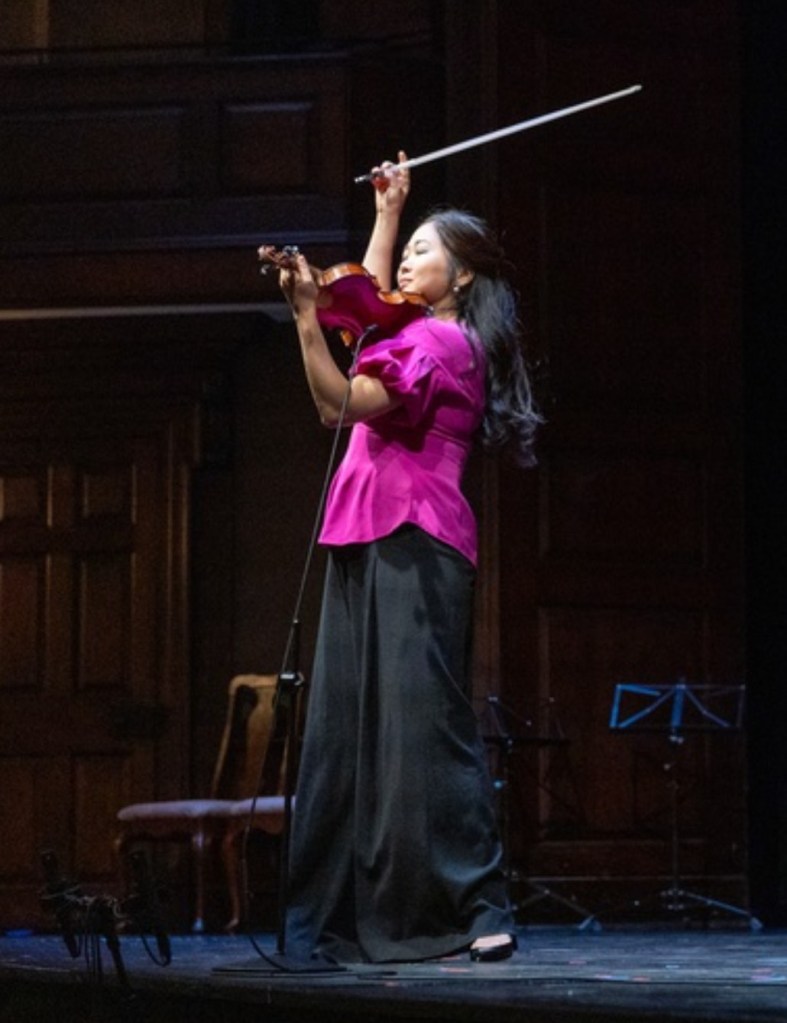
Throughout, O’Connor seems to pull out every trick in the strings’ book. There is a nice, plucked-staccatoey section, there’s a moment where both performers were so pianissimo that it made everyone so quiet you could hear a banjo-pick drop. Ayane Kozasa (also of Kronos Quartet) shares an equally precise and fun viola, warmer in sound, and more often with an accompanying harmony, although at times taking over the melody, as well. For the most part, this was a rollicking folk dance, with two virtuosic moments at the finale that were somewhat unbelievable. I didn’t know a violinist (er … fiddler) could play individual notes up and down that fingerboard so quickly, but Kristin Lee seems to handle it effortlessly. (I mean, what were those – 4096nd notes?! And what do we even call those? Demisemiquavers-squared?!)
At the end of this short opening number, there is such an enthused, climactic crescendo back up to the main jiggy theme that it was very hard not to give in to the Dionysian urge to get up — get on up — and start stomping around that ol’ Dock Street Theatre!
Que Legal Quintet
Next up is the uncommonly performed Quintet for Flute, Harp, and String Trio, by Heitor Villa-Lobos, and what a gem! Villa-Lobos was a Brazilian who brought the Western classical artform to Brazil – and vice versa. His tone poem Amazonas premiered in Paris in 1929, and he sounds like he was out-Messiaening Messiaen before Messiaen with his tone poem about a Brazilian bird, Uirapurú, that features themes from the bird’s song, directly. He even went full-Ravel and transcribed Enrique Granados’ piano suite, Goyescas, to orchestra! (Although sadly these are reportedly lost?)
To have a warm string trio behind a harp and flute is an interesting quintet, and Villa-Lobos exploits the arrangement perfectly. Luscious strings complimenting these two brighter instruments from the orchestra that at times play hot potato with the theme right along with the strings, but at other moments give more of a nice ambiance — almost side effects like birds here with the flute or that old TV-show trick of summoning a “wavy flashback sequence” with the harp’s arpeggios. In the opening Allegro, Allison Loggins-Hull’s flute has a nice section, with a repeating staccato-like arpeggio to accompany the warm strings, behind. But at other times, the flute is lock-step with the strings, the notes and phrasing matching alongside, precisely.
The second Lento movement is just so lovely. It starts with the trickling of a harp’s descending theme, played as lazy as a hot, humid Charleston summer (did Villa-Lobos meet Gershwin?), with the flute echoing, going back and forth in a call-and-respond. All while the cello, then the rest of the strings – played wonderfully by Jennifer Frautschi on violin, Kozasa back for more viola, and Arlen Hlusko on cello — play dreamy slow notes in the background, like the ocean lulling you, somewhere in the distance. This theme is within a pentatonic scale and is just one example of why Wiancko pointed out some “French Impressionism” influences with this composer, having trained in Paris. (Although many of those scales were, themselves, taken from Asian influences, of course.)
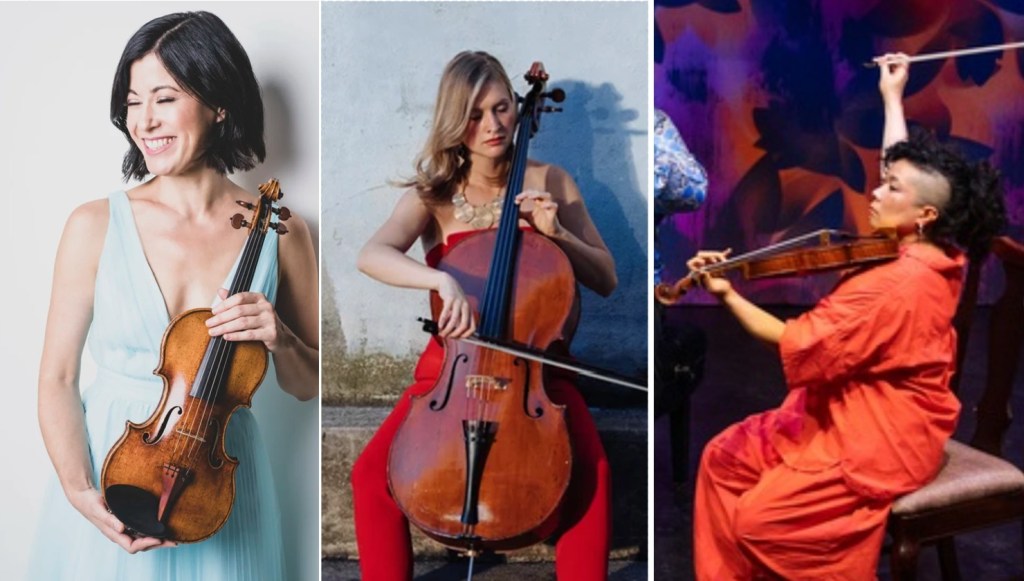
The third movement starts with a fast, nervous theme like rushing through a bustling Rio de Janeiro street, intermixed with sweet, slower passages, with an obvious finale that was met with enthusiastic applause for our que legal (super-cool, in Portuguese) quintet.
Visually, the quintet was awesomely diverse — four ladies and a man, two African Americans, two Asians, and a white lady. And for the harp — one of the stereotypically “feminine” instruments — the instrument is played by our very big, tall fellow, Charles Overton, who stays on stage after the piece to give us – ….
A Harp Solo!
Not on the official program, Director Wiancko couldn’t help but insert a short piece by harpist, Overton, when he found out he was also a composer. The only thing sweeter than Overton’s composition, “Once More” – the first he ever performed publicly — was his preface to it, as he eloquently described how a modern composer has to overcome the fear of presenting something publicly as a “composer,” when one is constantly overshadowed by the likes of Beethoven, etc. He finally realized that, “we all have our own stories to tell,” and he had to finally just “get out of his own way,” and just do it. It was a beautifully motivating personal speech for any young composers out there.
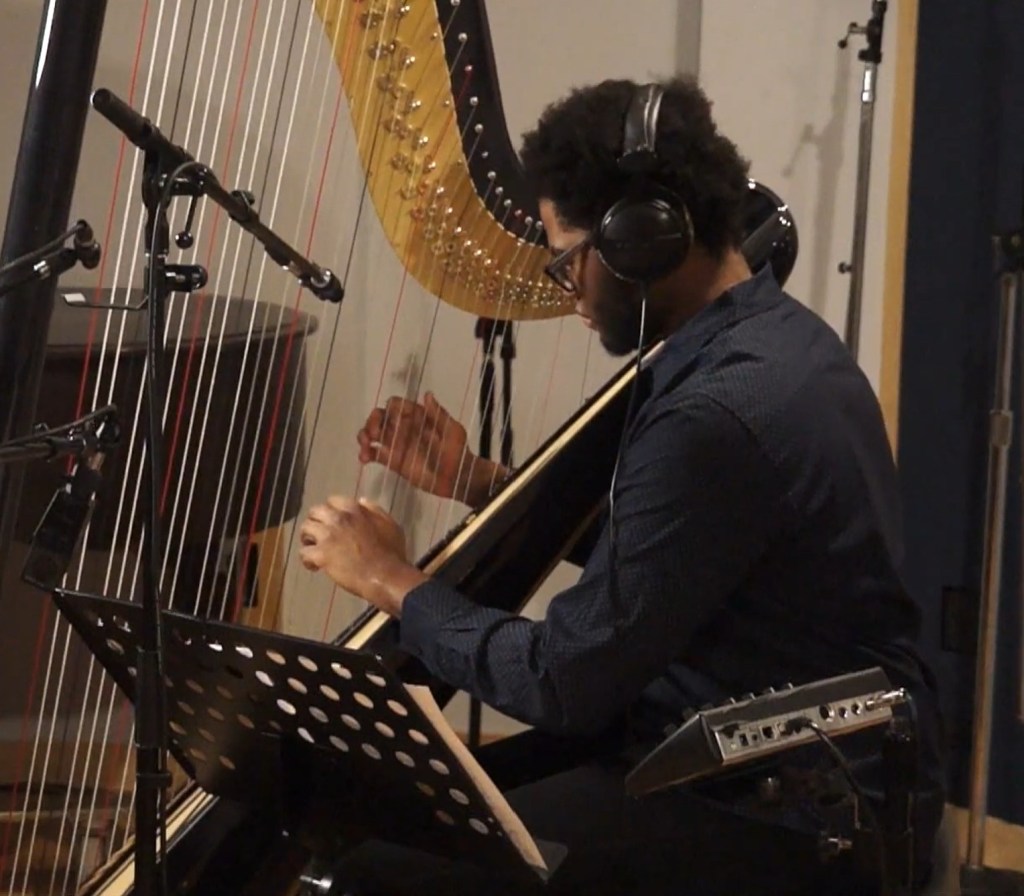
Praising the piece afterwards, Wiancko seemed to joke that 5-year-olds stayed quiet and enraptured when they heard the piece on a promotional tour, a week before the festival started. We laughed. “And I’m not joking!” he pointed out! Oh yeah — of course he isn’t. Those of us who know 5-year-olds know very well that to have a classroom full of young children sit quietly through a classical music piece?! – (especially today with Tik Tok and “verticals”) – is probably higher praise than any blowhard art critic (ahem!) could ever possibly muster.
Did I mention that Charles Overton is a big, tall dude? Well, with this soothing, jazzy harp piece, he proves he is exactly like that correct stereotype of lovable, bigger dogs — nothing but the most gentle in his playing. When Wiancko asked if he’d come back to Spoleto in the future, he said “yes” — and how could he not? Of course “Charles” belongs in Charleston!
Cool Cat
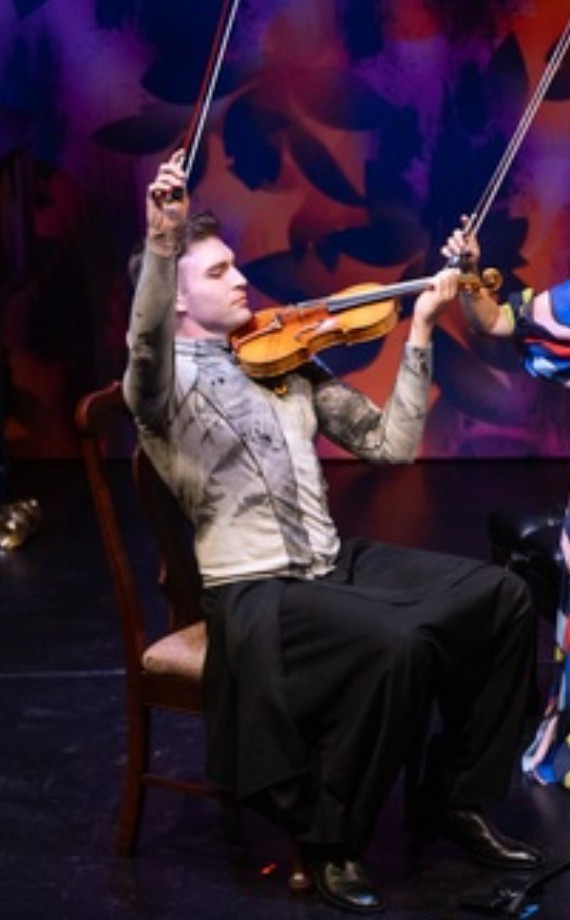
Concluding the program is Felix Mendelssohn’s Piano Trio No. 2 in C Minor, bringing together the flamboyant Alexi Kenney on violin, our incredible cellist-M.C., Paul Wiancko, and practically conjuring Mendelssohn’s spirit from the grave, the lovely Soyeon Kate Lee on piano. While this C Minor Trio has still not quite escaped the towering shadows of Beethoven and Schubert, it is nonetheless a magnificent work in its own right. (Thank goodness Felix “got out of his own way,” as Overton might say.)
Wiancko prefaces the piece by stating Mendelssohn was “plowing forward with such energy,” publishing the piece just a year before his untimely death, and in the opening movement, he is right. It opens with a wonderful exuberance that at the end yanks immediate applause reflexively from the audience, who have been such a “proper” classical audience through the program until then, and thus “knew better” – but they just couldn’t be stopped! It was too good!
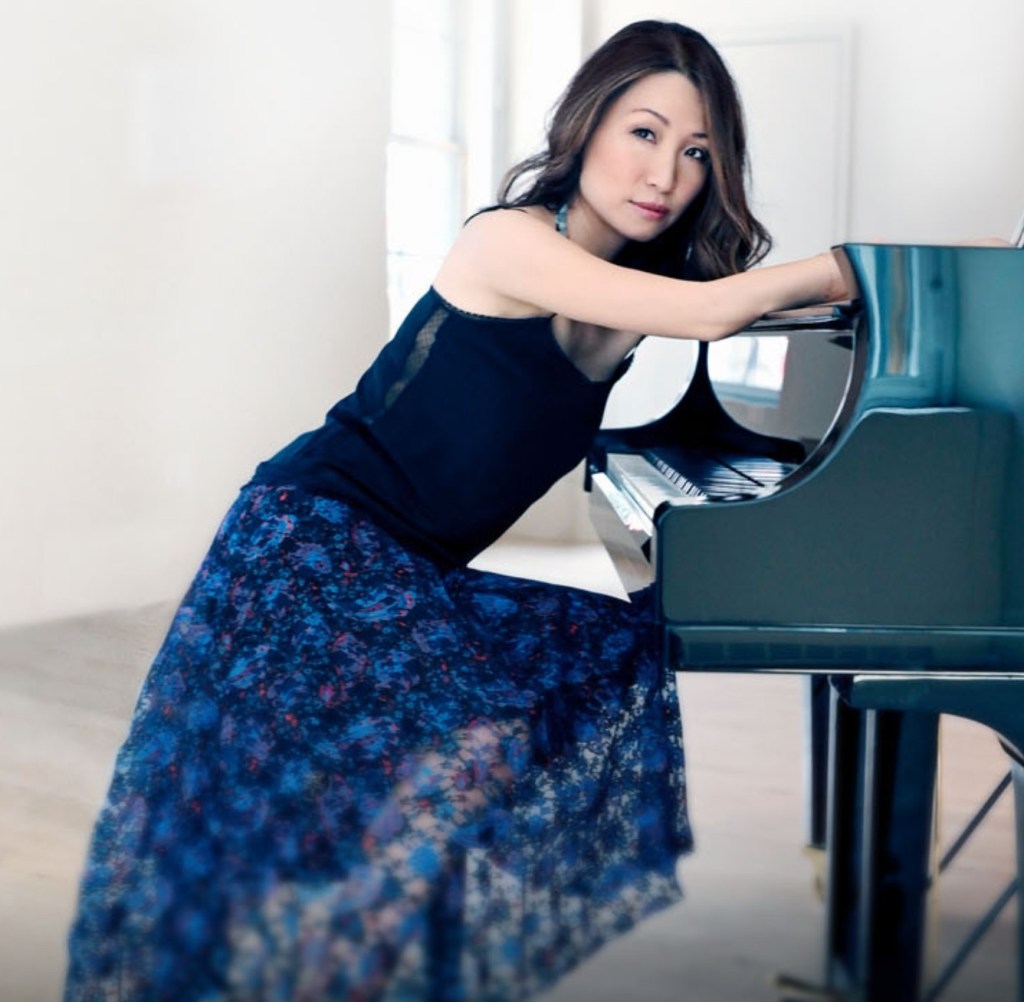
The second movement, the expressive Andante, starts with an endearing solo piano, played oh so affectionately by Soyeon Kate Lee, with form and harmonies very 19th century, and a singing quality to the melody that matches Schubert, (or, for myself, Beethoven’s 27th Sonata, 2nd movement). Cello and violin join in seamlessly, almost dancing with one another, if sound could do that, and although stemming from 19th century Europe, I can almost hear American settlers on the prairie singing some related melody….
How startling, then – after such an affectionate-like love letter – to startle us with the third movement, the Scherzo, which Wiancko prefaced by joking, “Mendelssohn called this movement … ‘a trifle nasty to play’ — self-aware enough to know you’re being kind of a jerk to the musicians!” (Of course, weren’t all the great composers, as we know? And to their defense, didn’t all the virtuosic musicians demand it, to keep proving themselves as “the best.” And thus, altogether, they kept raising the bar higher and higher through our glorious centuries of classical music culture?)
And Wiancko, playing cello, was notably tasting ‘the nasty’ as he worked through the movement. His face was in 100% complete concentration through the movement, enveloping — nearly bear-hugging — his cello, ferociously, and all worth it, wonderfully bowing out those tricksy fast parts for us.
Alexi Kenney came out kinda cocky in a stylish dress, earring, and hipster shirt (perhaps trying to outdo the Kronos Quartet’s famous early punk days). Yo, Alexi — when you do that you better deliver the goods, man. … Oh. … Oh, wow, he did. … My bad. … Kenney hits the notes and plays with just the right intensity throughout, and is an obvious master of his instrument. (So, I give in — he’s a joy both to listen to and watch, with all that flair! I do apologize!) The ending fortissimo pizzicato section for our strings stood out, and the crazed movement ends with an almost exasperated gasp from the audience, as if we’d all just run a marathon.
While the fourth movement could be compared to Beethoven’s Ninth Symphony’s fourth movement, given its triumphant feeling and sharing the use of a chorale (although in Felix’s case, it is a hidden chorale theme, from the 16th century), it opens with a phrase near-stolen from the Ninth’s 2nd movement, to my ears. I was humming the theme after the program, and accidentally segueing into the Ninth, and didn’t at first know why…. This has to have been an intentional homage.
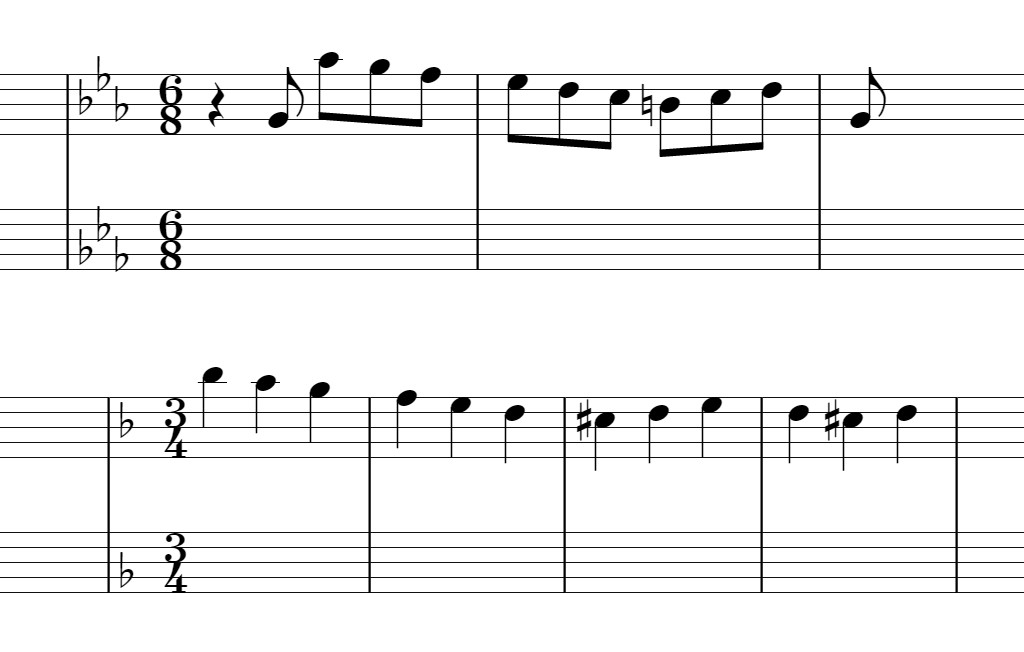
Before this piece, Wiancko sang a bit of the chorale theme – and then something magical happened. One audience member from the balcony continued the singing – then a group of at least 10 to 20 audience members all joined in and for a brief 10-15 second chorus, as if we were in the midst of a congregational hymn. I can’t remember the last time I experienced that sort of beautifully interactive spontaneity at a classical performance. Thank you, Chamber Music Series and audience!
This piece is as equally awe-inspiring as it must be daunting for its performers, who did such an amazing job they received a deserved, prolonged standing-O to conclude yet another groovy program in Spoleto’s Bank of America Chamber Music Series. (Yeah, sure – I’ll give the corporation some credit. As Fran Lebowitz recently said, these newer bajillionaires are adding nothing to society, so I’m gonna give a little credit to those old-school capitalists, when it’s due…). What a Piano Trio! The only thing – really the ONLY thing disappointing about Mendelssohn for me is that he discouraged his sister Fanny from publishing, because she was a woman (a little dickish by today’s standards – “Point, Schumann!”). But otherwise … this C Minor Piano Trio, and this Felix fella? He is one cool cat.
Copyright May 27, 2026.
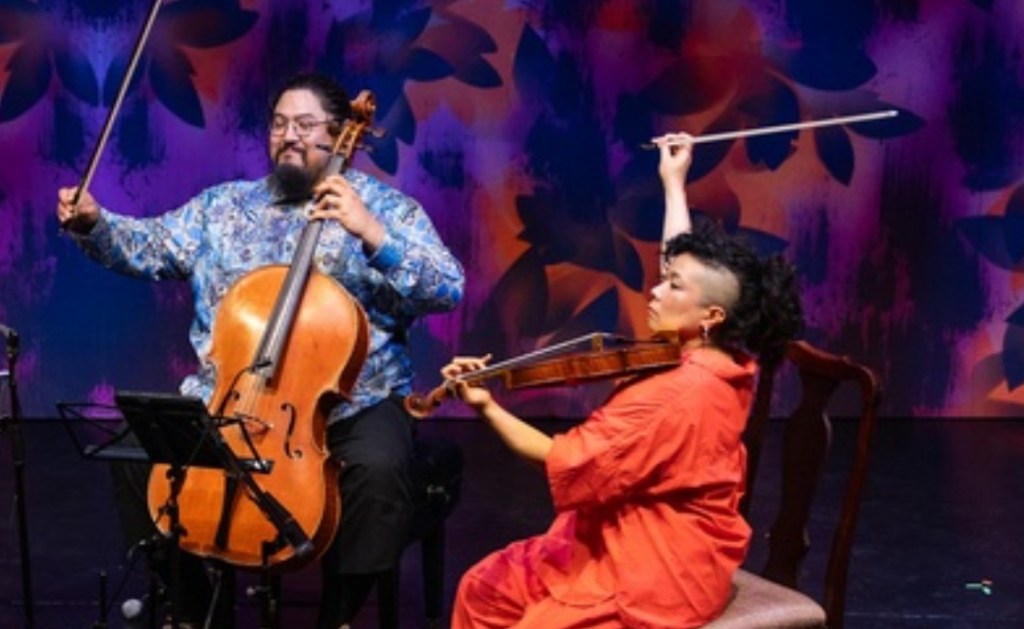
Featured image: Cellist Paul Wiancko and Violist Ayane Kozasa. Photo by Erich Schlegel for Spoleto USA.
This article also appears in BroadwayWorld.
S.E. Barcus is also on Facebook.
 S.E. Barcus
Leave a comment