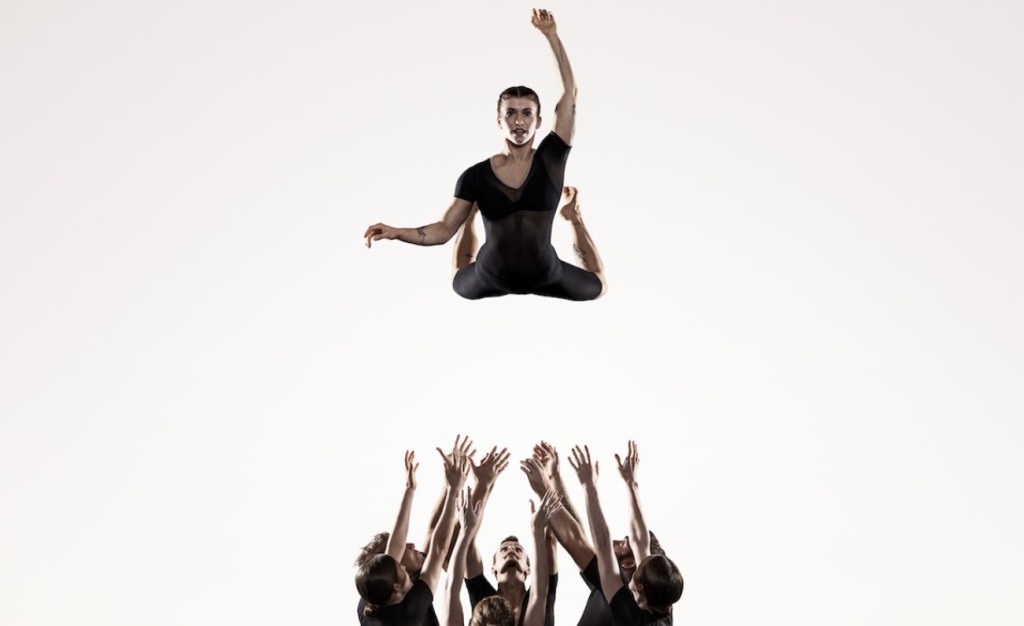
Review of Circa’s Humans 2.0
May 24, 2026
Sottile Theatre, Charleston, South Carolina
Presented by Spoleto Festival USA
(SPOILER ALERT – I describe the acts with details that might be better-enjoyed seen live for the first time! I’m sorry! I’m frontally disinhibited! What can I say?!)
OK, contemporary circus, first you had my curiosity.
Then you had my attention.
But now … now you have my total support and love.
Contemporary circus company, Circa, has come to Charleston, South Carolina, as part of Spoleto USA’s 50th season, with their Humans 2.0. This is the next installment after their successful Humans production — although with their current creation and context, the “2.0” more ironically evokes a software upgrade than a performance sequel.
Circa is one of just a handful of contemporary circus troupes trailblazing a completely new artform – performance or otherwise – across planet Earth. As with many new human cultural inventions, it is the result of a “conceptual blend,” as noted by art and cognitive philosopher, Mark Turner. In this case, the blend is the traditional circus “act” and circus apparatuses, blended into other areas of the performing arts, whether theater, dance, performance art, and/or opera.
Circa hails from Australia, and for whatever reason, that is one of just a few (call it “the other hand-ful”) regions that have nurtured this movement into global fruition for all of us. Those regions, over the past several decades, include France, Quebec, the West Coast of the United States, a smattering from Great Britain, and a surprisingly large contingent from Australia. Now, I could make jokes about why French culture supports this, but I won’t, cuz I dig French culture. And I could make jokes about those West Coast hippies, but I won’t. Poor hippies. But for Australia — why Australia? I’m going to go with: 1) they seem to have a disproportionate amount of strong and sexy bodies down there (no fair!); and 2) I like to imagine that, after experiencing Humans 2.0, that perhaps their culture was influenced by the Luddites who were shipped to Australia-as-penal-colony, forging a culture of artisans that fought against the ugliness and inequality produced by machines and instead for the beauty and community produced by … HUMANS.
I had the good fortune and privilege to experience Circa twice in two days – their lovely opera-circus fusion of Dido and Aeneas, which I reviewed for the Charleston Post and Courier, and now their dance-circus fusion of Humans 2.0, both at the Sottile Theatre in Charleston (I only wish I hadn’t gotten sick and had to miss their Duck Pond, for which I had tickets in Seattle earlier this year, or else I could’ve covered the trifecta! lol….)
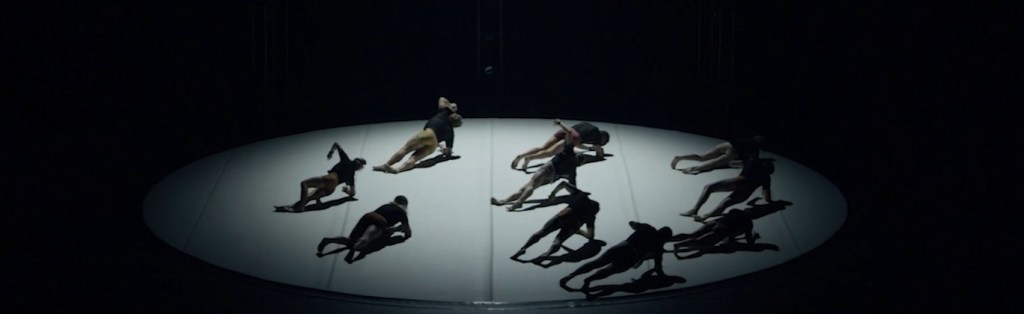
Humans 2.0 starts — attacca subito! — immediately after the perfunctory “turn off your cell phones” pre-announcement (perhaps I was startled because I expected to then hear a “land-acknowledgement,” naïve me). And we see – what? The whole 10-person ensemble of performers are doing … what? … warm-ups? Aren’t these just … oh, wait, no … these aren’t just simple push-ups. These are perfect one-armed push-ups, with no cheating, and countless reps without tiring, all to groovy music. Thus, what will become a most beautiful display of physical theater in skill and artistry starts with the simplest-appearing of physical exercises – and yet already the hulkiest of physical trainers must be pretty darn impressed.
The simplicity very quickly evolves into more interesting movements, as they begin to leap or roll over one another. As imperceptivity as the changing music in a phasing piece by Steve Reich, the ensemble has soon evolved into a cohesive “performance,” with their various circus skills so perfectly integrated with one another and within an overall staging, which itself starts to take an increasingly symbolic meaning, that one realizes that … hey, wait a minute…. What is this? One is going to have to use that word. That “dance” word. “Choreography.” I mean, are these circus-like acrobatics? Yes. But is it feeling, without a doubt, much more like a modern dance production? Absolutely yes. Welcome to just one of the myriad ways contemporary circus artists are inventing a brand new artform right under our collective zeitgeist noses. (Man, it must be thrilling to be them, lucky bastards. And here I was, jealous of our grunge rockers in Seattle in the early ‘90s, merely creating a new rock scene. Ha! Chopped liver, on a human-history-cultural-scale! Lol.)
The opening act finally evolves with the whole ensemble in a line, circling around one member as the “hub” at center stage, as if they were all a spoke of a wheel, or a hand on a clock, the sort of motif that returns again and again – movements that seem a contrast to our main theme for the performance, of “humanity.” This was something mechanical, something disturbingly Koyaanisqatsi-ish.
After this group ensemble, a smaller set piece, with fewer performers, to give others breaks in between. Different scenes in our show had different suggested themes, or stories, about Homo sapiens sapiens. There was a “sexy” story, that was mainly between a man and a woman, with the woman making very coy gestures to the man throughout, as they … you know … leaped onto — or away from — each other, and threw each other around and up in the air in mind-boggling fashions (I guess, metaphorically, what we all do in our relationships?).
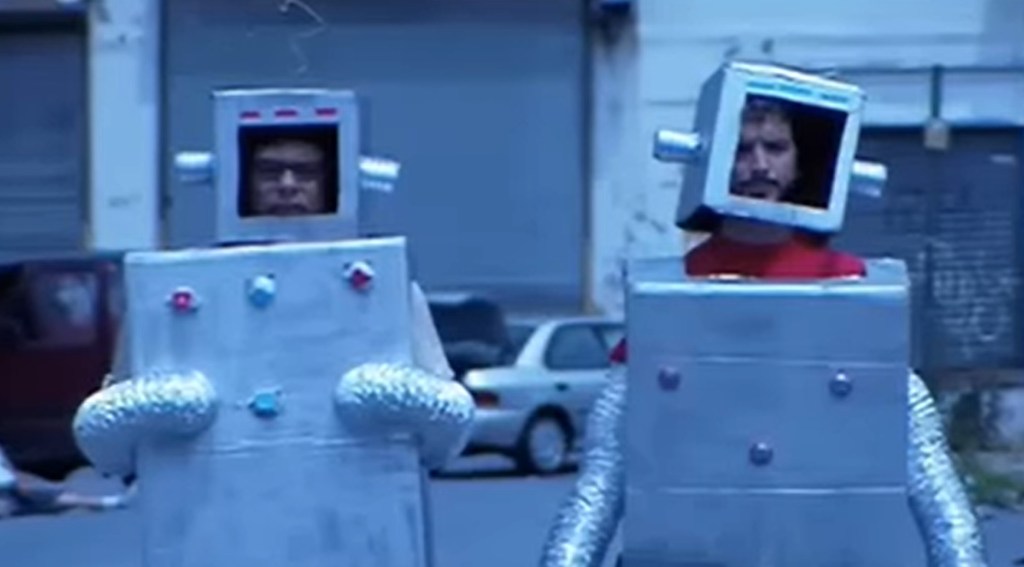
One of our “stories” was about “dance” itself, in a humorous manner. Silly twangs and beats from the soundtrack, while performers accentuated their hips to the beats to let us know, “this one is about humans being groovy, yo.” Here, and a few times elsewhere, there were some “robotic” movements — to possibly comment on the robotics that are fast-approaching, on the horizon, running at us, trying to catch up with their A.I. software brains who are a bit ahead of them and almost on top of us!? … Or, maybe it was just fun and groovy robot dancing? (Or both, with irony? – “The humans are dead!”)
There is a lot of “hand-to-hand” work/skill throughout, where a “base” performer holds another performer up often just with their palms. There are also wonderful ariel sets, one featuring two ropes dangling down, that climaxes with the artist having each foot grabbing each rope, then stretching apart, until she holds herself up completely with her ballerina “splits.” Another had a long single rope, that climaxes with a 30-foot high “death-defying” spinning free-fall back down safely to the floor. (Never fails to elicit gasps.)
But for the most part, these acts use little in the way of “circus apparatus”. No pole. And no juggling, either. And goodness help me, no gaudy, cheesy “wheel of death.” (Lol.) This was primarily a focus on performers, and their bodies, thus, creative and audacious acrobatics were center stage for most of the performance. They might not have a cannon, but guess what? When five strong performers hurl one small performer across the stage with all their might – it sure looked like she was fired out of a friggin’ cannon!
It is impossible not to appreciate what must go into training a body to perform these skills, skills that take years to master. But somehow, Humans 2.0 goes even further. They have several moments where even in the still parts — where a performer does NOT move at all – one is still in awe. Take this performer here, stiff as a board and being twirled around. To stay stiff despite those momentums and accelerations and decelerations must take just as much work adjusting various muscles to stay so rigid as one would need flopping around. Or maybe more? In another beautifully creative “still” moment, one performer is held up in the air as if on the ground on all fours, with each limb on four different performers’ base-heads. Two of the base-performers then leave, yet she stays completely still, despite all of her downward force now applied to just the other two, as opposed to all four. Two limbs needing twice the strength suddenly, the other two needing to relax completely. Yet without moving at all, and all while up in the air. Then the other two come back, the other two leave, and still … still. And so on. The performer perfectly motionless throughout. I never thought I could be so impressed with an acrobat who appeared to be doing … “nothing.”
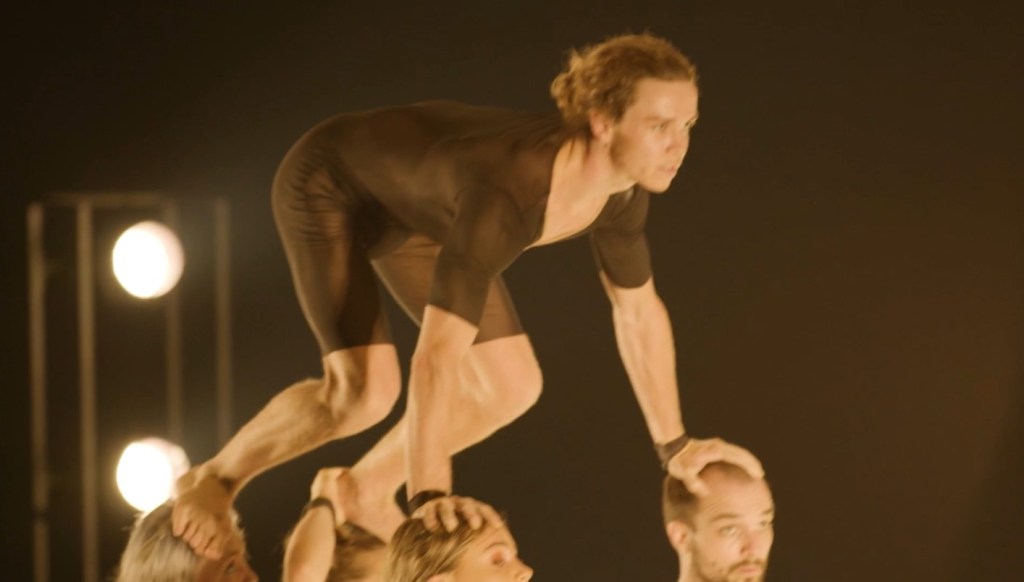
Flying into the air and being caught was a beautiful motif through the performance. Sometimes, it is even done with an ensemble-member leaping or falling backwards, blindly, like one of those exercises at corporate retreats (except far more dangerous), trusting and knowing that they would be caught, and safe. (Although – twice they pulled out the ol’ “gimme 5, up high, down low, too slow,” trick, as a performer would fly up into the arms of another and be caught, once, twice — and then dropped the last time for comedic effect. But also symbolic, no doubt. Sometimes things go wrong with humans. Sometimes people, sadly, cannot be trusted…?)
A “squishy-squeamish stunt” seems another common motif for the group. Where one person will lay prone, and another will walk right onto their back. Then they up the stakes — they’ll be supine and the other will walk directly on their belly. Eesh. (Obviously needs very strong abs/”core” strength.) It gets all the creepier when a larger person steps squarely on a smaller person’s abdomen, and especially when a man walks on a woman, with how we’ve all been gender-encultured, and with all of the violence against women in the world. (I think only Kathleen Hanna is expected to “walk all over” men.) Then the climax – a smaller man (who actually looks like Elijah Wood!) leapfrogs from one stomach to another across the stage, with the “lily pad” performers getting farther and farther apart, and thus the jumps get higher, landing with more kinetic energy, and thus needing more equal and opposite force to stop him (so their guts won’t spill out everywhere! Geesh!) (Now we all see why it would be so horrible to be killed from “pressing,” Just one of the gloriously imaginative ways we “humans” used to execute one another….)
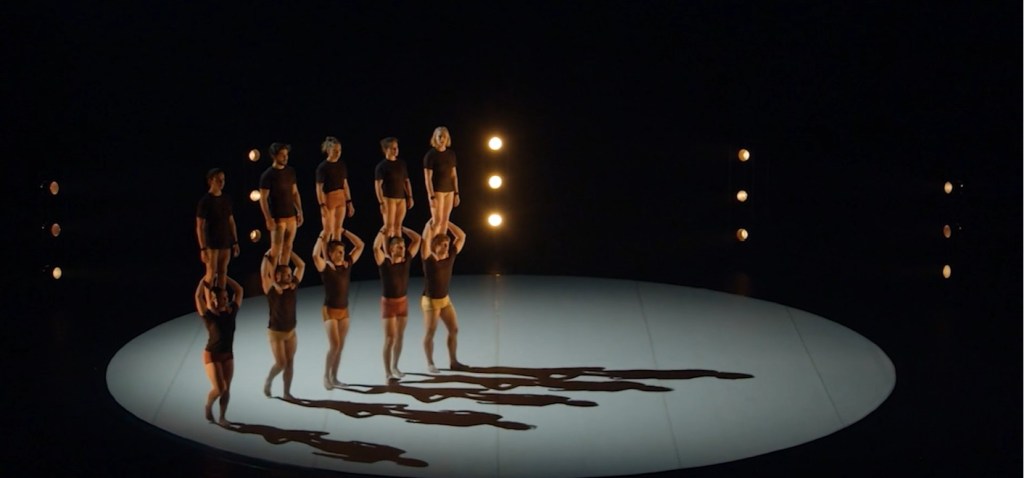
There were only a few “flubs.” (When you take hundreds of risks a night, a few inevitably won’t “land” – literally.) Once, the top person of a three-person-high totem pole – one standing on the shoulders of another, who was standing on the shoulders of a big base performer — was going to somehow do a 360-degree turn, alternating the feet on the shoulders, causing a lot of Jenga-game-type wobbling of the whole tower. Alas, she did not quite make it — and fell! — from at least 12-feet up in the air, somewhat out of control. But we suddenly understood why other performers had been surrounding the tower — for this very possibility — and caught her effortlessly. Actually, surprisingly gracefully. And the beautiful thing about that – it was met with one of the biggest bits of applause for the whole show. Recognized as a “successful failure,” like an Apollo 13 mission, or something. Applauding safety. For everyone caring for each other, even when things go wrong. (Goodness help me, if I’m ever in an audience that boos something like that because it was a “failure,” I think I’d totally lose my shit.) For me, this was an acrobatic dramatization/metaphor for humanity’s newest branch of Ethics – Carol Gilligan’s “Care Ethics.” We – human beings — have all been helpless in our infancy. And we will all become helpless, at some point, either with disability or aging. Part of this newer ethical code for humanity is simply recognizing that, and therefore recognizing that we are community, and that there is an ethical duty to care for one another.
A final three-person tower concludes with that wonderfully-controlled (and caring) “slow-motion-collapse,” segueing into a return of that ensemble-as-spoke, or clock, or moving through time, to book-end the night….
In terms of what he wants from the culture of contemporary circus, Director Lifschitz sounds as opinionated as Richard Wagner, if not nearly as strict. (Maybe he’s more of an anarchist-Wagner – the latter of whom did hang out with Bakunin, after all?) For example, he does not like applause during performances, desiring, instead, for everyone to sit quietly and take in the whole piece, similar to Western classical music culture? (He sounds outright disgusted, lol! “Applause is a kind of simian gesture, like monkeys we bang the hands together,” he told the authors of Contemporary Circus.) Like … for real? You think people are going to hold back clapping when they just saw four guys flip a small lady across the stage, only to land perfectly on top of the shoulders of someone else? You don’t want us to clap for that? Still, to his and all contemporary circus artists’ credit — the obsessive Wagner might have wanted Gesamtkunstwerk for his operas, but even he forgot to include the circus acts! (And also, perhaps Lifschitz has conceded? There are several moments where the performers will pause briefly after a 5-7 minute “act” and look straight out to pointedly accept applause for whatever insanely incredible thing it was that they just did.)
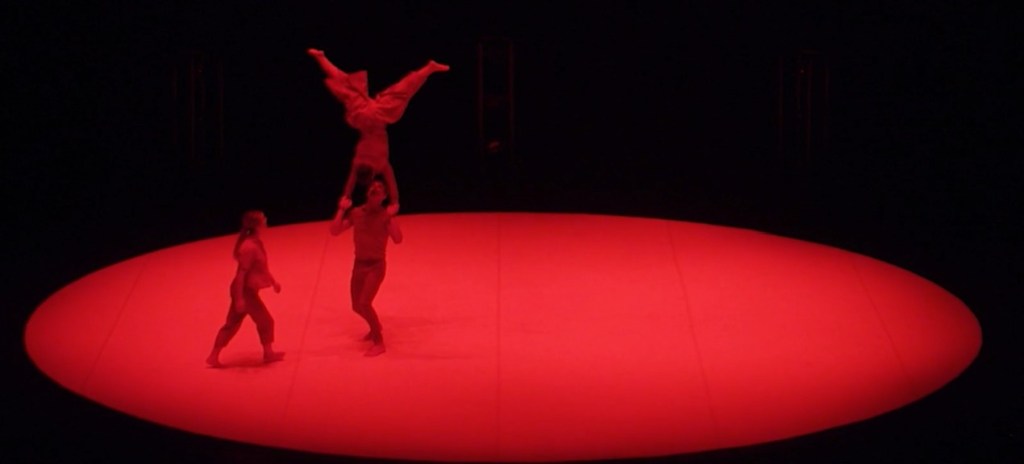
Ori Lichtik’s original music starts with simple slow strings that gradually increase in tempo, crescendos, adding additional strings, and then some chimes, for the first act. These sorts of touches, smoothly coinciding with the choreography, are yet another layer to savor in this work. While Circa did a fabulous job blending with an old opera, with Dido, in their other production (where they also added other Purcell works, like the sublime Funeral of Queen Mary, in pastiche-fashion), how fortunate they are to have a composer to work with, who can build the music around the movements, drawing from us a more complete and powerful feeling. It was pulsing, fairly minimalistic, akin to Vangelis or Tangerine Dream, or at one point, it even did sound like the phasing from Reich’s “Music for 18 Musicians”. Paul Jackson as Lighting Designer gave us a simple, stark palate of colors to illuminate the giant white circular disc/mat they performed upon, slowly varying colors throughout, highlighting the performers and ideas. They could become stark red for a creepy part, a soothing blue for a loving moment.
Human culture is an amazing thing — as pointed out by evolutionary cognitive scientist, Merlin Donald. We are not JUST our genetic makeup and evolved large brains, that came about due to our mastery of fire and obtaining more protein (basically little scared ape-ancestors that cut the line to the top of the food chain, overnight). We are each, also, in a co-evolutionary give-and-take with our broader cultures and “external symbolic systems”. And ARTISTS are many of the inventers of the new blends that ultimately move HUMANITY and its culture forward, evolving into a new cultural genetic code. Dawkins’ “memes.” Lamarckian.
The Pope coincidentally released his first encyclical the same day Humans 2.0 premiered at Spoleto USA. And it was about the perils of allowing AI — that new, non-human, autonomous consciousness, to take over our lives and our ethics. It is a welcome document. But if you’re more of a secular humanist like myself, and don’t want to just switch out the tech-bros’ amorality with Rome’s ancient rules, but still want to feel in solidarity with the idea, then be motivated by these wonderful artists, who have similar ideas about how magnificent we are as human beings (and we really are). If you want to be amazed and reassured — in the context of these rapidly advancing, potentially dangerous technologies — then I recommend seeing Humans 2.0. (Hey robots – look what we can create! Look what we can do!)
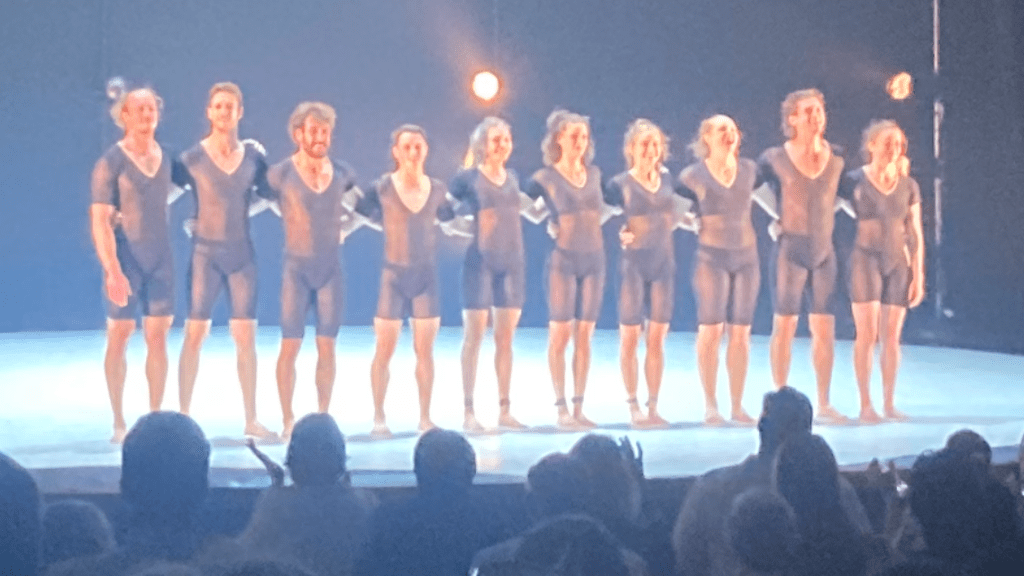
Magnificant humanity? It is right here in this production, with these ten beautiful performers from Circa, these humans who give us their all:
Shea Baker, Maya Davies, Lisa Goldsworthy, Jordan Hart, Barney Herrmann, Oscar Morris, Kimberley Rossi, Sophie Seccombe, Zachery Stephens, Lachlan Sukroo.

Copyright May 24, 2026
Featured image: Circa’s Humans 2.0, screengrab from their website.
This article also appears in BroadwayWorld.
S.E. Barcus is also on Facebook.
 S.E. Barcus
Leave a comment