Review by S.E. Barcus
Our House
By John Longenbaugh
Produced by Battleground Productions
July 17, 2025
Breaking the fourth wall of traditional theater has seen quite a surge in our time. There are works of theater that are “immersive,” such as New York’s amazingly surreal rendition of Macbeth with Sleep No More, or London’s trippy warehouse of freakiness you can explore, in Alice’s Adventures Underground, or even plays in Seattle’s newly dedicated immersive theater space, LIT Immersive. And then there are “interactive” theater productions, where actors interact directly with audience members, from the Stage Manager in Thorton Wilder’s Our Town, to the more invisible, didactic theater of Augusto Boal, to Second City’s improv comedians in Chicago taking audience suggestions. And finally, there are works of art that are “site-specific,” made and intended entirely for a specific PLACE, such as Mary Jane Jacobs’ famous and deeply thought-provoking Places with a Past exhibit in Charleston, South Carolina.
However, it is a rare and special treat to get to experience a work of art that is all three of these things at once. Yet, behold — there is a play that just opened in Olympia, WA, that is, indeed, all three of these things – immersive, interactive, and site-specific – all at once. John Longenbaugh, ‘longen-time’ Northwest playwright and theater critic extraordinaire (and now film producer, by gosh), has revived said play, from last year’s successful run, Our House.

Yes, the play is immersive – for Act 1, you are on the porch with a group of characters on a front porch, you’re in the living room for Act 2 voyeuristically watching a couple on their date, and then to the backyard with a … vaguely reminiscent couple … for Act 3, while a wake is going on. (We’re even given a program for the wake, and everything — which was a nice, immersive way to sneak us the play’s program without us feeling like we were watching some play, or something!)
Interactive? Check, as the Our House Stage Manager talks with us directly, just like the Stage Manager did in Wilder’s Our Town. Yes, this play is a not-so-subtle, and very sweet and impressive, “HOMEage” to that famous American classic, which the playwright explicitly spells out for us in the program notes.
Finally, the performance of the play is, indeed, site-specific. Bona fide. And at the playwright’s actual house. Which is also the set. … Um, let me try to wrap my head around this exactly — the play is set in … this house, which is also the playwright’s current house. The house is a sort of main character, itself. And is also the current inhabitant’s inspiration for a work of art. … Aside from being economically shrewd in these ridiculously expensive times for real estate, including for theaters, this is an extremely courageous production approach. I believe our local Seattle theater heroes, the Ewalds/Kazanjians, did this somewhat recently. And Wally Shawn famously did this while working out his play, The Fever. But I don’t know about you — I could never do this. My neuroses would cause my head to explode! Kudos to the playwright for this intimate invitation, and a warm thanks for his hospitality, including those delicious cocktails and hors d’oeuvres that he bragged about – and then DELIVERED on! (No joke! Yummers!) Like the play and the house itself, you might start to get the feeling, halfway through the “production,” that this guest-host relationship is for REAL. And thus, I am now sort of feeling guilty that I did not bring a bottle of wine to the party, as I write this…. (Sorrrrrrry!!!) And I’m really not so sure who is getting more ‘immersed’ – we, into the play, or the playwright himself, into his lifelong profession!
A side note — Wilder’s Our Town is often said to be site-specific, since it is said to be set and performed in the very theater in which you sit. But if Our Town was truly site-specific — at Grover’s Corners, “42°40′ North latitude and 70°37′ West longitude” — Wilder’s play would, in actuality, drown you somewhere off Massachusetts’ coast. In practice, Our Town can be, and has been, performed in hundreds of different theaters. “Theater” is a more Platonic, formal “theater,” in the case of Our Town.
But to potentially get a REAL feeling of a real PLACE – that is, to be TRULY “site-specific” — the work must be made FOR that place. Which was so clearly and pain-stakingly done in the creation of Our House. And therefore — if you care (which I do) — and if you let it, if you think about that context while experiencing the play (and not just consider it a gimmick), it can give you that extra sort of existential umph. The old cemetery behind that hill over there, that is often referred to by the characters throughout the play at the different decades? Cock your head — look over there – there it actually is, and always has been. As crows and seagulls flew over our heads in the cool evening, while the characters talked on the porch, I imagined crows and seagulls just like these could very well have flown overhead back then, just like this. Enter crow. Exit crow. … Good job, crow. … Break a leg, crow.
You can know that, while these characters are fictional in the same way they were fictional for Wilder’s play, this space – this “set” – this very house was here just like this, before any of us in the audience were even born. Word has it the playwright did a lot of research on the actual times and people of the area, to give the play even more verisimilitude, such as a crazy French neighbor from the 1930’s, and her crazy chickens! (I wondered if the current neighbor thought the actors were talking about her!) (And, so sorry, but for my own juvenile joy, while I sat in the front yard during Act 1, I could not help but note that, yes, like the Madness song, we were, in fact, in the middle of the street! … 🙂
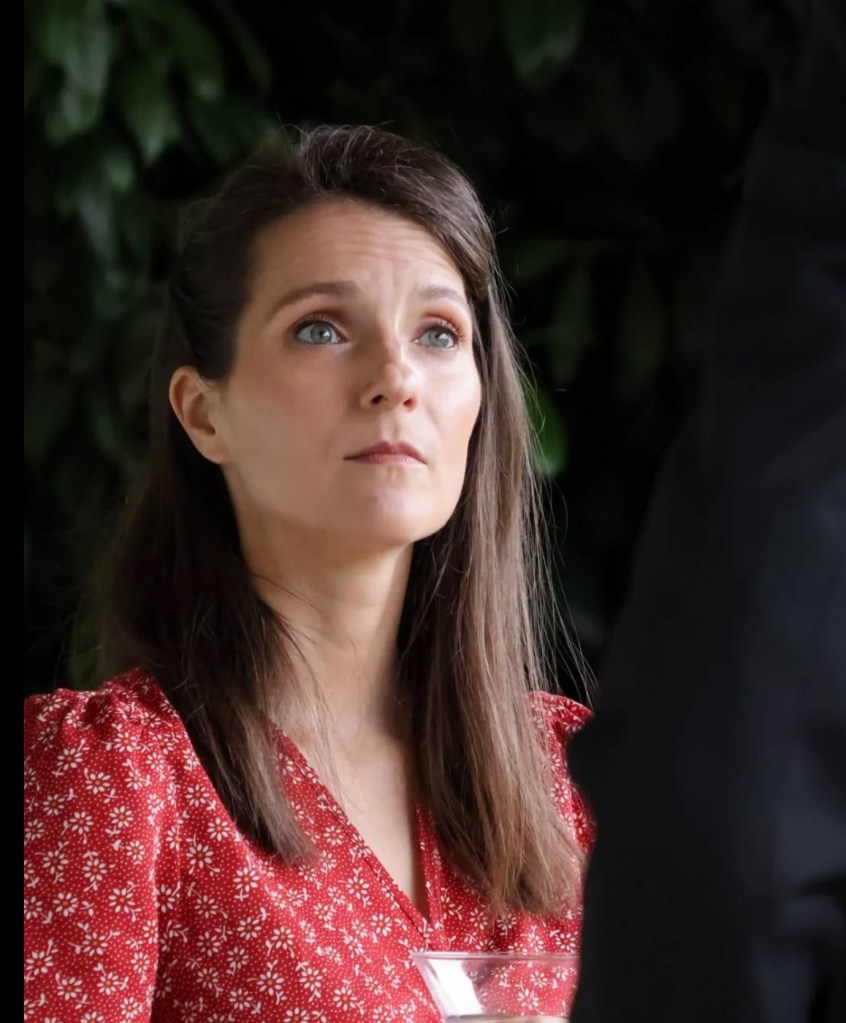
Act 1 begins in 1934, on the porch outside of a dinner party. Callie, played by the charming longtime Olympia actress Hannah Eklund, has returned home from trying to make it on the Great White Way. She is sweet and somewhat elegant, but seems to be hiding some pain – Broadway seems to have been a place a bit too mean for her, filled with “stinkers”. She’s back in Olympia, and to the party, purportedly contemplating a try at Hollywood (“Cali?”), and has escaped to the porch for a smoke. Out comes Mrs. Whitmann, who knows that Callie has a thing for her son — she can see the lipstick on the wall. They chat — FDR has only recently come into power, to right the wrongs of unregulated capitalism and its great Depression, and we hear stories such as how wealthy banker-type Americans call FDR a socialist, while Mrs. Whitmann’s French neighbor (again — right over there in that house to your right) thinks our socialism is relatively quaint … compared to the French guillotine….
One can feel how the larger world’s hardships affect these folks, including the young man who “enters,” Ed Whitmann, who is still living at this home with his mother to save money — and who is very thankful for his job, any job right now, working for the state (doing some nebulous cataloging work that sounds as mysteriously bureaucratic as the warehouse at the end of Raiders of the Lost Ark). But eventually these larger backdrops dissolve as the human story emerges, about the local cemetery, the house itself, and finally Ed and Callie, themselves, their past love, their current tribulations, their plans for the future – possibly with each other…. Somewhere in the midst of the drama, I note the “set” design – with a street address adorning a front porch post, behind the characters, signifying where the play is taking place, for us in the audience … and for my Apple Maps.

Actor Mathaeus Andersen, as Ed (and later as Daniel), has mostly successfully suppressed ihis Danish accent (which might prove that he’s a good actor, but still makes me sad – cuz I needs me some Mikkelsen! :), and he both physically, and in terms of his sweet sincerity, reminds me somewhat of comedy actor, Ben Marshall from Please Don’t Destroy. He can easily go from kind – the past “sucker” for Callie — to suddenly becoming surprisingly self-aware and a bit angry due to his hurt feelings, but then seamlessly back to tender again, once Callie opens up about her true hardship and feelings.
For Act 2, set in 1989, we sit in the living room, watching a dinner date up-close-and-personal. As you get to walk around this house, feel the old walls that have been there for a hundred years. Go ahead and peruse the photos and books and tchotchkes during “intermissions” (when you’re basically literally mingling with fellow audience members at a house party). You’ll find that the photos are of the First Act’s characters, and answer some of the questions raised at the end of their Act. This is akin to sifting through video games for Easter egg objects, which adds more to the story, and adds a – textural – veracity to the whole experience. Oh look, those wood-carved elephants and knives on the shelves? Jerry — who now occupies our titular character, on a date in the living room — must have brought those back as souvenirs, since he tells us he went to those countries as a journalist. Jerry, it turns out, is the son of Ed and Callie, played by another longtime regional actor, Mark Waldstein (who is also our kind and somewhat playful guide for the night, as the Stage Manager).

Jerry is having his on-again, off-again love, Amelia, over for dinner. The time is those H.W. Bush years – with ribbing about his CIA history, and with an optimism at the fall of Communism. And then the world moves in closer again — more local history – as we learn that Amelia has just landed a job for some newly rising company in Redmond called “Microsoft”. Actress Meghan Goodman, who was a fine Mrs. Whitmann, really shines in her role as Amelia. She’s got a very Melanie Griffith “Working Girl” aura and vibe to her (a movie that – bingo — came out in 1988), a gal who likely started in the 70’s as an eco-socialist but as she has gotten older, is looking forward to the salary and benefits that will come with her new career. Meanwhile Jerry is content living in this simple house of his parents, and has left the rat race. He loves smaller-town Olympia, with its Pet Parades and his job as an archivist. He’s “old-fashioned” with his books, while she’s “new-fashioned” with 1980’s style and her digital thumbdrives (and darn it if I don’t hear that Madness song, again, trying to play over Jerry’s Miles Davis…). By the end, we understand that these two, who so obviously love one another, somehow might never manage to completely connect. Which is dramatically exaggerated to make the point, yet on an existentialist level, might be the saddest reality of the human condition. As sentient, empathetic human beings, we are, in a way, eternally trapped within our own subjective consciousnesses.
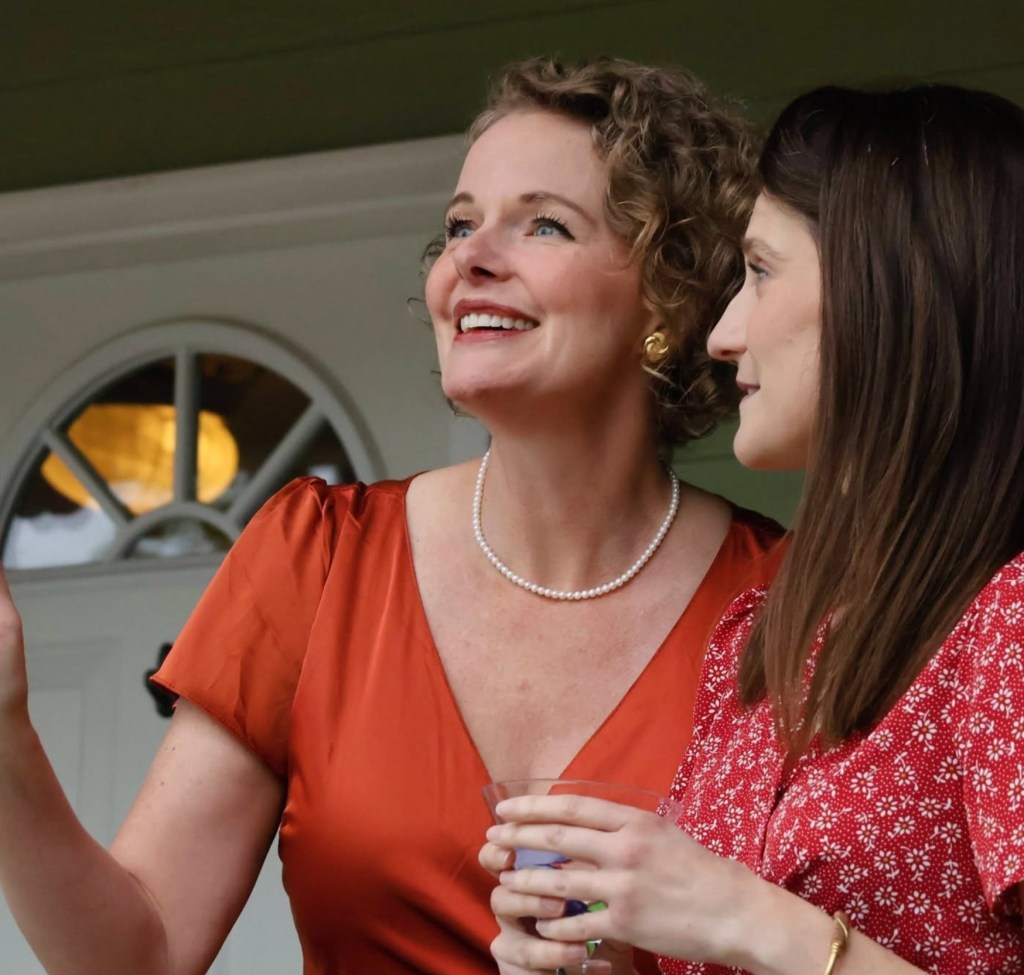
While the immediacy is about “place” for Acts 1&2, Act 3 is not only set IN the actual backyard, but is also happening RIGHT NOW, on this evening in 2025 – which Wilder did not do in his play. (This rendition also must be an update from last year’s production, as Biden is now out, and the malignant narcissistic kleptocrat is in.…) So, Act 3 could be played as a TRUE “happening”. In the same way as John Cage’s 4’33”, this fact could focus a listener/spectator to both the Here (“space”) AND the Now (“time”). The dialogue subtly refers to this, as Bennie (played by Ms. Eklund) muses on cosmological distances and times, while enjoying the backyard telescope. Our current reality is such a relatively short “blip” in time and space. Actually, she ponders, “blip” is too long of a word to even get the idea across. We are more of a, “bl-. Mathaeus Andersen, back as the modern Daniel, likes Bennie, but is floundering in his own life, as are many young people, in our current era of thoughts of the Cascadia subduction zone causing “the big one,” or an asteroid hitting us, or despair over the red lines we have already passed regarding climate change, or — “oh, you go ahead and pick whatever catastrophe you like,” to paraphrase the Stage Manager. The couple is unsure of the future, yet attracted to each other, nonetheless, and … in part due to being played by the same actors, if different characters set 87 years apart … there is something between these two that feels like déjà vu. Like something recurrent. Like something eternal.
That’s the other nice ‘reinvention’ on the conceits of Our Town. In this play, the life of this place is stretched out over three different times, with three entirely different sets of people, as opposed to dealing with just one community in the early 20th century. Sure, Wilder had themes of the eternal, but having three completely different sets of characters — yet with all of the same human struggles and themes — dramatizes/demonstrates that feeling of ‘the eternal’ even better, for me. These people are different, yet they are the same. ‘She’ is the wondering, dreamy actress here, then the dreamy ideological eco-activist, and then climate scientist there. He is the bureaucratic man here, an archivist there.
One last dare-I-say improvement on Wilder’s play — both take on the theme of ‘those little things’ being immensely important. Our whole raison d’etre, and such. Yet I think that that theme hits “home” harder with a house, as opposed to a town. When one thinks of “home,” one cannot but think of the things that really matter. Our actual lives and the closest people we love. The Universe is just too vast, if awe-inspiring. The nation-state is important, but also too big. A “town” does get a lot closer to what truly matters in this “Think Globally, Act Locally” sort of message. But if we deny solipsism, then the next thing for our minds and spirits to grab a hold of, that really matters, is whoever is there in your very own House. Read those silly Madness Our House lyrics. Or the lyrics in Crosby, Stills, and Nash’s different version of Our House. Or Simon and Garfunkel’s Homeward Bound. Or John Denver’s Take Me Home, Country Roads. Or Home on the Range (forget the racist section against Native Americans). On and on. People cannot sing songs or write poetry on the subject of home without it reverting to an ode to the every-day, to those simple, “meaningless,” and “ordinary” things … that are actually just so goddamn important to us. That are, it turns out, everything.
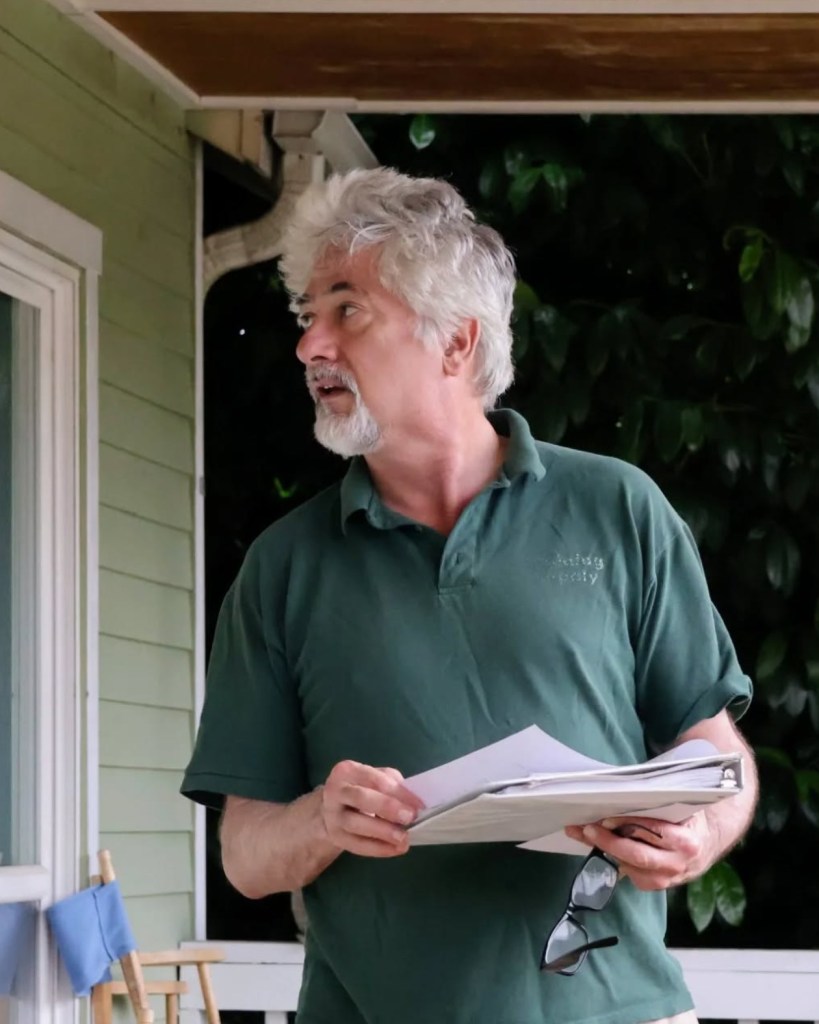
Longenbaugh’s playwriting, the dialogue, itself was straight realism, and naturalistic and well-crafted enough to make Callie’s dream playwrights Eugene O’Neill and Ibsen proud. Themes are subtly sewn through the whole play, tying it all together, while human-relational plot twists and reveals come at us efficiently and adroitly, with characters having believable and emotional changes – all within each individual act. Just expertly crafted, theater by a very experienced playwright.
It makes sense to me that a more interactive, immediate theater is gaining ground. Theater’s advantage over mediated drama — whether on the big screen or little screen or in some AI-generated VR headset — has always been its real-life interactions. It was a wry joke of the playwright when he had his 1938 Mrs. Whitmann tell Callie that she shouldn’t go off to Hollywood, since ‘live Broadway shows will always be preferred to movies.’ While in reality, live theater has been “dying” since the beginning of the 20th century, thanks to movies. To come back, theater needs to continue to leverage its real advantage over mediated art. And its real advantage is … it’s real. These incredible Our House actors are real-life human beings right in front of you, unpredictable and witty and empathetic and reactive, and you are there actually living that experience with them, on your night, during this relatively short “blip” we all have in this time and this space. Or, rather, this short “bl-
Copyright 7-17-2025


 S.E. Barcus
Leave a reply to John Logenbaugh Cancel reply