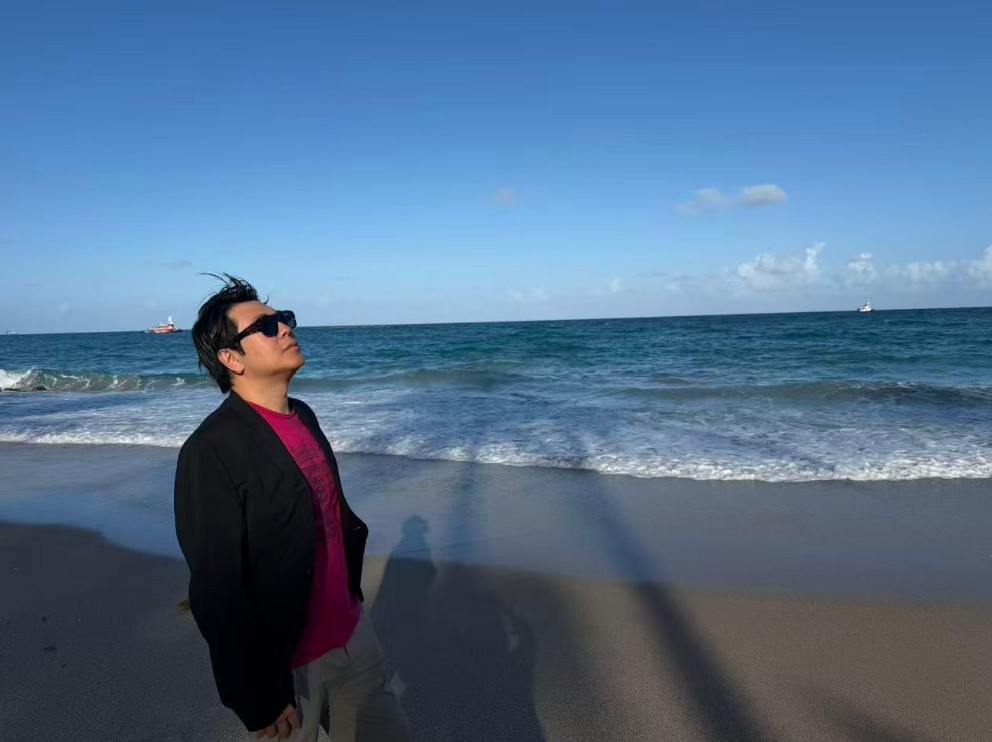
Lang Lang’s 2026 Piano Recital Tour through America
March 20, 2026, Benaroya Hall in Seattle
By S.E. Barcus
Lang Lang — recently off his stint playing for another Olympics –performed a wonderful piano recital at Seattle’s Benaroya Hall on Friday, March 20, delivering everything for which he is known. Delivering the goods. He has been arguably the world’s most well-known pianist almost since storming out of the gate in Chicago in 1999, today with only Yuja Wang sneaking up on him (using his same strategy of ‘rock star’-fame-meets-incredible-classical-virtuosity). At 43 years old, anyone attending one of his 2026 performances will get to watch him in arguably his greatest decade — physically, anyway (arthritis does start to creep up on us in our 50s…). (He, himself, might point out, of course, that “body-be-darned” — an artist only becomes more and more emotionally and mentally wiser, and more expressive, with every passing year, as Martha Argerich would likely attest.)
He started the night with the lovely Mozart Rondo in D Major (that is not really a rondo, but a Haydnesque sonata). In case you somehow didn’t know (?!), one sees right away that Lang Lang’s body language and facial expressions are an integral part of his performance, and much more communicative than your average pianist’s. Even with this mostly sweet, delicate piece, the body was always moving. As he played, he gently swayed his trunk from side to side, head tilted up, swaying along with it, earnestly enjoying the music, as if he were having a pleasant walk in a park, smiling, basking in the sun, beside the trees, the children playing, the rabbits bouncing about…. He was just … somewhere else, and was taking us on that journey with him. (Of course, all while knowing ery well that the sold out Taper Auditorium of 2,500 audience members were watching him keenly.)
His body language here somehow reminded me of Chico Marx’s playing of sweeter tunes, enjoying the piano playing so much, himself, that one couldn’t help the desire to gather around the piano to enjoy it with him…. Even Chico’s “pistol finger” was a technique very nearly used by Lang Lang, throughout, as he would frequently, all night, use just the pointer finger – left or right hand – to knock out a few notes in a row in an exaggerated fashion, staring right at them, typically with forearm raised quite high so that each note pressed could be seen as well as heard, even at the very back of the auditorium – and at times, on a forte moment, flicking the finger off the key with an even more dramatic, large amplitude arm movement — flailing up, down, backwards, or to the side.
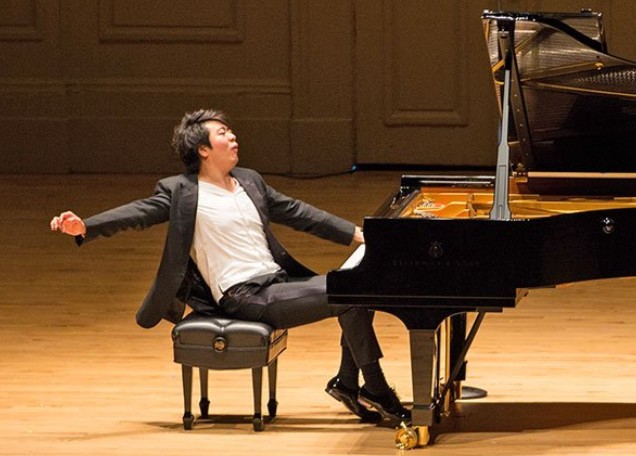
When one hears that Lang Lang is a very “communicative” artist, as masters like Pavarotti (5’50”) and Herbie Hancock have exclaimed — this is, in part, what they are all talking about. This “exaggerated” bodily technique. Not the “correct” technique one learns from a piano teacher, as to how to play, say, a slow arpeggio “correctly” up the keyboard with the right hand (thumb, pointer, middle, then cross the thumb under and repeat, and so on, so as to make the arpeggio seamless and easy on the fingers, etc.). No – with Lang Lang – one will instead, at times, see a big arm movement, with pointer-finger-only, going up the whole arpeggio, slowly savoring each note. Often looking right at that note, like he’s having a conversation with the keys, and the piano, itself. And while this might not be the “correct” technique for pianists, it sure as heck is correct technique for a performance in a large auditorium, because even that person in the very back can appreciate what he is producing and expressing for them, just as easily as if they were sitting right there next to him during some piano teacher’s living room recital. This is the “technique” of a Showman. And a friggin’ super-genius of a Showman, at that.
Besides playing the Mozart piece with as much fun as Mozart must have had writing the variations on the one theme, we see another of Lang Lang’s techniques. If one hand is not playing, it is still almost always moving. Typically with a wavey gesture, directing the other hand, essentially conducting it – and again, visually demonstrating the sound waves being expressed. I’d bet money that those who are Deaf or hard of hearing probably enjoy Lang Lang’s performances more than most other pianists. His gestures and facial expressions throughout are just so universally communicative.
When done with the Mozart, he bowed for the applause, then fell right into the Pathetique’s first crashing chord — before his butt even hit the chair! Now, it’s hard to get the same sort of “SURPRISE!” out of the Pathetique’s famous sudden bursts of extreme dynamic changes that Beethoven first shocked audiences with, over 200 years ago. No one had ever leveraged the potential, and relatively new power of — DYNAMICS! — on a keyboard instrument before Beethoven did with this very sonata. (It is a “piano-forte”, after all!) So, here, over 200 years later, jumping into that first chord so unexpectedly, before we had even stopped applauding the previous piece, was a consciously good decision by our performer.
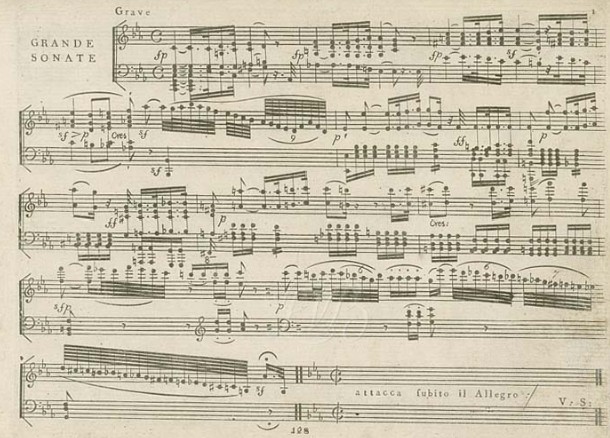
I read all the time that Lang Lang plays “too fast,” in order to show off. (“It’s not a race, Lang Lang,” one armchair critic recently wrote on a Facebook post.) And indeed, many of the chromatic runs, or the passages with galloping broken-octave-tremolos, in the Pathetique’s first movement — and for several other moments throughout the night, as well — were lightening fast. And abruptly so, with no gradual rubato. More subito/sudden/”surprise!”. And yet I was a fan of these tempo chain-yanks this night for two reasons. One, it’s just fun. Lang Lang’s expression during these almost manic sprints looked exhilarated and enthused. Sure, it made the segment seem a little more “show-offy”. But I think that is the least of his concerns. (And besides, for those in the audience who wanted those virtuoso moments, they will go home happy.) More importantly, I think he is just, plainly, enjoying himself during these moments. It’s just who he is. And when Lang Lang enjoys something, you will find yourself very hard-pressed not to enjoy it right along with him, as he can be really, really infectious. The second reason this works is, here, in a piece so famous for its dramatic and sudden dynamic changes, why not pair it up with dramatic and sudden tempo changes, too? It thematically works for this piece, in particular.
Speaking of this, the end of the first movement is so fast and furious and exuberant that with the final ffz-forzando, the audience reflexively burst into applause. (Like, I think it was literally a monosynaptic reflex, like the knee-jerk. Nothing conscious about it. You would not be a normally functioning, physiologic human body, if you did not react to that last chord with the same cheers and applause.) I don’t hear that at Seattle Symphony’s Hall too often — people “inappropriately” clapping, en masse, between the movements of a sonata or pieces within a suite. How DARE they! The bloody OUTRAGE! (lol.) It belied that a good chunk of folks there that night were not stuffy classically-enculturated season-ticket-holders (as also evidenced by so many families with young children! So cool! And so amazingly well-behaved!). So, thank you, super-stars like Lang Lang, for doing that. For bringing sexy back – to classical music, and getting butts in seats. Always, always welcome.
It also meant the applause was not perfunctory but was spontaneous and sincere. Warm adulation for the music. I found absolutely nothing wrong with it and wish we had more of it throughout the year. And Lang Lang’s response, he who has played countless auditoriums around the world, perhaps some where the culture would frown on such behavior? He did not get up for a full bow, no, but he also did not shame us the way Malofeev did with his stern (if somewhat playful), “no-no-no” head shake. Lang Lang simply turned his head for a moment to acknowledge the applause, bowed his head slightly in thanks, then proceeded onward into the lovely and famous, Adagio cantabile. Appreciative, polite, professional, all in one moment.
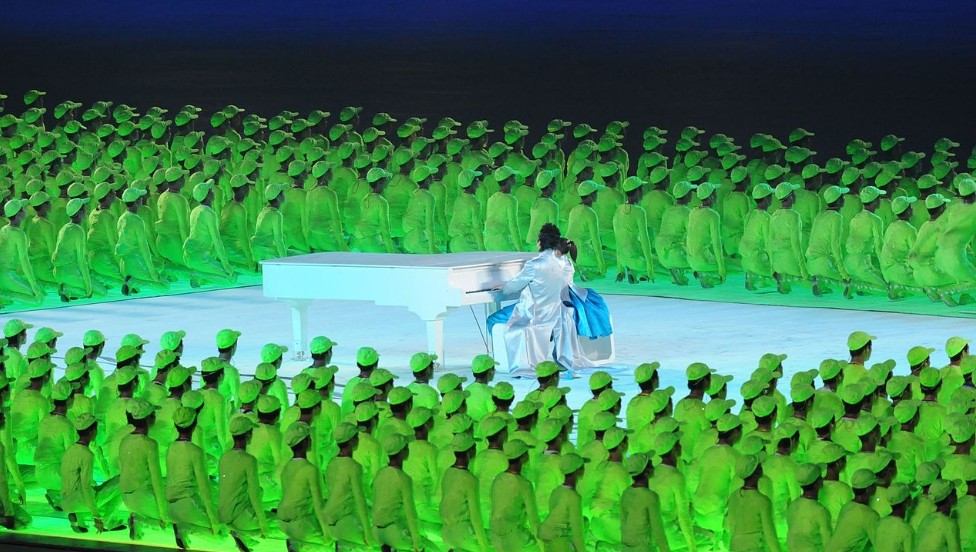
But also — flamboyant. He might not have the long hair of a cheerleader to do a hair toss, but he’ll still throw his head backwards, dramatically, at times, nonetheless, to accentuate forte chords, and to take in the whole sky above him. (Although — he did dress a bit more conservatively for Seattle, in a nice black suit, not the cool white suit with white turtleneck, like he wore at the recent Milano Cortina Olympics. Or the groovy blue silk pants and white caped-suit-jacket for the 2008 Olympics.) To finish the Pathetique, he alternated between that pleasant Chico body language and the first movement’s ferocious one, depending on the phrasing. And continued to tap notes individually with one pointer finger, very ostentatiously, slapping a note, or after hitting it, pulling the hand up or out, like a wizard with a wand, or a dancer. He is first, and foremost, a crowd-pleaser.
With the next Beethoven Sonata (No. 31), he again conducts himself with the left hand when it is not playing, as in the “amiable” first movement’s light, fast arpeggio with the right hand. The second movement, a scherzo, is a return to the Pathetique’s rapid-fire — and this time humorous — alternating of quiet and soft. But the last movement, the Adagio, is where Lang checks the box for a “full range of emotion”. He entered the lamenting arioso with such a feeling of desolation that, for me, it recalled the most haunting moments of either Les Adieux’s “Abwesenheit” or the Adagio of the Hammerklavier. Just really heartfelt and beautiful. The fugue was crisp, and as far as I could tell, perfectly executed, every voice very clear. Maybe not as insane and strict as the fugue in the Hammerklavier’s final movement. More bouncy and fun — like the fugato in Hammerklavier’s first movement, come to think of it. And a Showman, all the while. At the end of the Sonata, Lang gave us sudden changes in pose with each right hand sforzando chord, like he was in Madonna’s “Vogue” music video or something. And if you thought you were hearing percussion, you were — it was his foot, tapping. (He was dancing!) These final attention-grabbing moments brought you back, if you’d been daydreaming, and thus prepared you to get on your feet for applause, to end the first half of the night. (Lang Lang never “overestimates the Viennese.” He knows “to give us a good *bang* at the end of songs, to let us know when to clap.”)
The second-half of the night brought us the Spanish selections we were promised. Six wonderful pieces from the Suite española by Isaac Albéniz. The Grenada so immediately Spanish that I could feel warm weather already coming, despite the darn cold Seattle was about to get again this week. The third, Sevilla, brought Lang’s foot stomping again, this time like an Andalusian flamenco dancer, with their sexy hard shoes. The fifth piece, Asturias (meant originally by the composer for his Chants d’Espagne), is another piece with a flamenco feel – and the most famous piece in the selections. It was originally composed for the piano, trying to mimic the tremolo technique of a flamenco guitar player, playing quickly (p-a-m-i) with fluttering thumb-fingers on one note. The piece also features – once again – abrupt dynamic changes from quiet to loud and back again, so perhaps this is our main musical theme, tying the night together? In any event, historically, the piece went full circle. Originally for piano, mimicking the guitar, it was quickly arranged for the guitar, until, by today, it has become one of the most famous pieces in the guitar’s entire literature. I rarely hear the original piano version on the radio, when it is played. (Darn you, guitar!!!)
The last Albéniz piece for the night, the Cuba, has so many rolls of arpeggios with such fun extravagantly rubbery fingers up the keyboard that I almost hallucinated Liberace’s rings on those fingers! There was even one moment (I wish I could show you video!) where Lang Lang paused, along with the piece, and literally put his finger to his chin like the emoji, “Hmm?” —

— before answering “the question” back on the piano. It was a sorta hammy gesture (very Chico Marx!), but it was also kind of adorable. Concluding, then, with a whippy ending that yanked from us great applause to end the Albéniz selections.
Enrique Granados was our other Spanish composer — one of his pieces from his Goya-inspired (so cool!) Goyescas, Opus 11. We got to hear #4, Quejas, o La Maja y El Ruiseñor (“The Maiden and the Nightengale”). The piece features a a sad cry from the Maiden. Throughout, and especially at the end, there are very lovely trills, like butterflies on the keys – or, well, nightengales, I suppose.
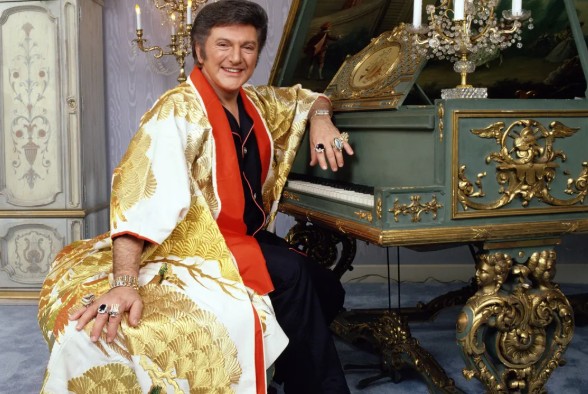
Two Liszt pieces end the night, a nice nocturnish Consolation #2 in E major, followed quickly by Venezia e Napoli: Tarantella. This latter is a great virtuoso piece to end a night — lots of those large amplitude arm movements, at times bilaterally, almost looking like he’s doing the breast stroke in those 2008 summer games. And again with just amazing fluttering of his fingers on those high note trills (oh, I’m seeing them again! Those rings! I see those rings! lol).
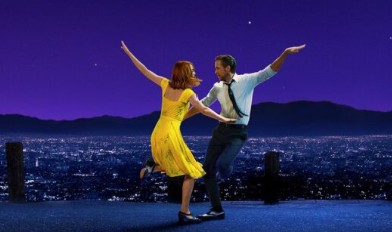
The much-deserved appreciation from the crowd was reciprocated with two encore pieces. The first one was — what?!, that’s not Mia and Sebastian’s Theme from La La Land, is it?! At first, snobby me, I thought playing this Hollywood flick’s song, by Justin Hurwitz, was a little cheesy. Lang Lang played us his Piano Book 2 arrangement, however, by Randy Kerber, complete with Liszt-sounding virtuosic runs up and down the keyboard by the end. By the end, I almost wish he had played the simpler version. It’s a decent piece of music, after all. Very sweet and melancholy. And all that pizazz took away from the jazz. While perhaps giving us the “encore-goods” – it somehow took away from the true soul of that piece. (This clip ends before the panache.) The multitudes of kids in this audience freaking loved it, however. It is a really famous tune, and he played it really well. So what the hell is wrong with me? Why am I such a snob?! Good job, Lang Lang!
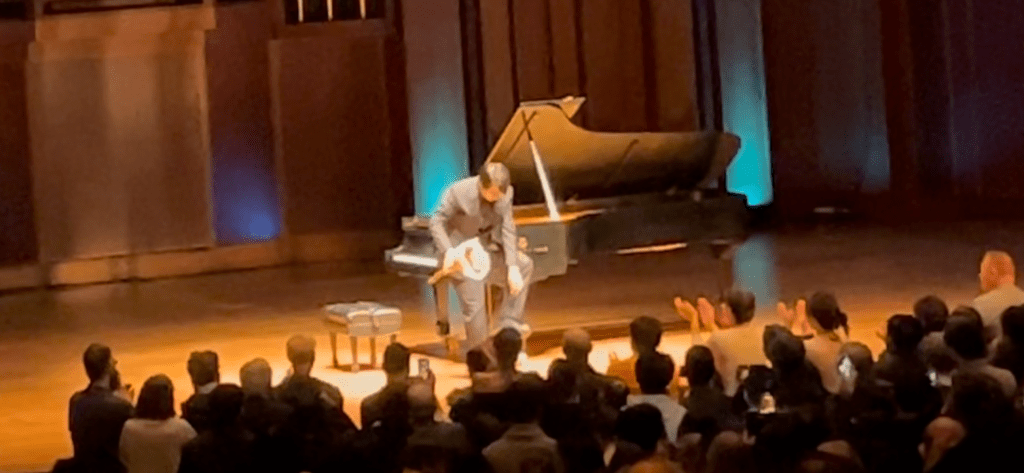
The final encore was Manuel de Falla’s Ritual Fire Dance. (Yay! One last Spanish selection!) Man, now this piece brought the fire – and it was absolutely NOT out of place. An intentionally flashy piece to end a piano recital by our world-famous, consummate, professional. Those flickery-flaming trills, by the way, besides being famously reminiscent of Rimsky’s bumblebee, feature a final unique gesture Lang Lang burned into our heads. He alternated hands while playing the prolonged opening trills, not just playing with one hand, but with both hands, alternatively, with large arm movements coming up and down, like he’s coming down on a timpani drum. If you have not heard this piece – it is a lot of fun. Yet another awesome “fire piece” to add to the piano literature! (Take that, “water”!) By the end, the reflexive applause explodes for a final time, along with flowers tossed to the maestro. And alas, a really wonderful night with Lang Lang was complete.
Looking back, I think the La La Land piece might actually represent Lang Lang in a nutshell. This is someone who obviously loves what he does, is an expert at his craft, both in technical skill and emotive communication, and possibly the best in physical/gestural communication I’ve ever seen for a pianist, giving us more of an audio-visual performance than just a sonic one. But he also just really wants to connect. La La Land connects, especially with a younger generation. La La Land says, yes, you can like pop tunes and still come to the Symphony. La La Land shows that he’s a little schmaltzy, yet still very sweet and sincere, and always happy to throw in that ostentatious flair to wow you. Basically, always making sure that the night you graciously chose to share with him — paying for tickets, blocking the date, getting dressed up, traveling to the auditorium, getting back home, ALLLLL that fuss — is going to be absolutely worth it, 100% guaranteed.
While I admire and support Andras Schiff for his decision to boycott the U.S. over Donald Trump’s bullying and cruelty (worsening every day), I am selfishly SO GLAD Lang Lang has blessed us in America with performances this year. They call him a rock star, but now I think Yuja might fit that term a bit better. However, if Yuja is the Mick Jagger (or the Kathleen Hannah!), then Lang Lang is much more the … well … the Showman. A modern day Liberace…, or Chico…, or better — given it is combined with emotional and technical expertise second-to-none — truly our day’s Pavarotti-turned-pianist, as Pavarotti himself told Lang Lang, so many years ago. For myself, I have absolutely nothing wrong with him. Play as fast you want, Lang Lang. I love it. I love whenever I get the chance to go on a vacation to Lang Lang Land! It’s such beautiful place!
Copyright March 20, 2026
Featured image: “Lang Lang on the Beach,” screengrab from his Instagram account.
S.E. Barcus is also on Facebook.
 S.E. Barcus
Leave a comment