Seattle Symphony Performs Widmann, Beethoven, and Strauss
2-3-24
S.E. Barcus
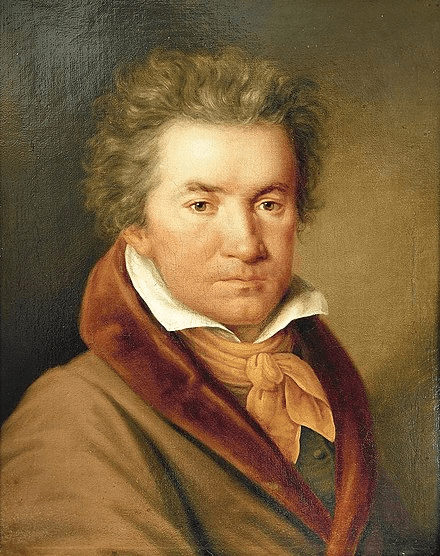
We had us a very Teutonic weekend in the “PNW” (insert nerdy Bromazon gang sign here), as the Seattle Symphony performed three Germans spanning three centuries – from Ludwig’s 5th Piano Concerto (the “Emperor”, 1809), to Richard Strauss’s tone poem, “Ein Heldenleben” (“A Hero’s Life”, 1898), to the relative “newcomer” (and reportedly 3rd-most performed living composer?!), Jörg Widmann, and his “Con Brio” (2008).
Our guest conductor for the evening, Kevin John Edusei, debuts with the Seattle Symphony for this program, and is, himself, from Germany. And his conducting style (with only the most sparse, economical gestures) is very … well … Germanic. Subtle. Not those big, exaggerated and pleading gestures stereotypical for Southern Europeans when they speak. More reserved, lower amplitude, but — as proven in some Northern vs Southern European gestural cognitive studies — undoubtedly/communicating just as frequently, with just as much information, nonetheless. I’m not sure Edusei’s foot-stance spread out any farther than his shoulder length the whole night, unlike other bouncy, roving conductors who seem more like caged-animals. And his wings stayed within those same landmarks, as well — unless he REEEEEEALLY wanted some increased volume. Then, an arm might very subtly be raised, and four fingers might curl rhythmically toward himself, like playing Eddie van Halen arpeggios on an air guitar, with a “come hither” gesture, to imply — “yah, so, a little more volume dere, please.”
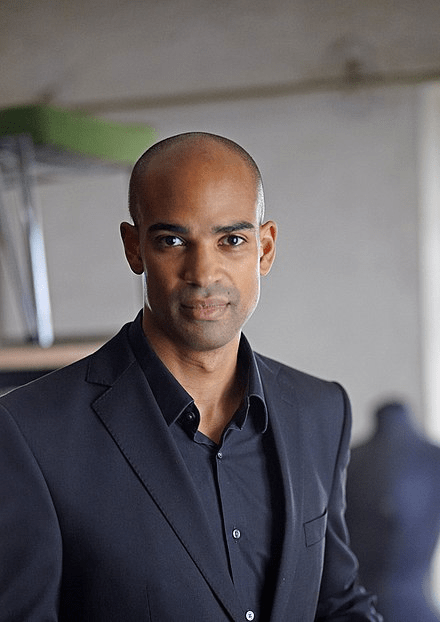
Sometimes, if I don’t know pieces well – such as the Widmann or Strauss, this evening — I might recommend looking to the conductor, for guidance, to get “the big picture.” Well, not with Edusei. Especially from the back. He is all business, very matter of fact, very terse with his musicians, and to the point…. Very stereotypically German-seeming.
This, of course, is not a bad thing. Just different. Overall a really fun evening — except … for just one little aspect of the Beethoven piece — perhaps that one was a little off-balance, needing more from the strings and less from the horns? (To be fair, this might have been an issue with my positioning, as the monstrous concert grand piano might have blocked the sound waves emanating from the army of strings.) Overall, the three pieces were performed as crisp and perfectly as if they were a recording. So, one has to give our Maestro credit for that – along with the ongoing amazing talent of the Seattle Symphony’s musicians.
[Oh – and as an aside – “Kevin John Edusei?!” That’s quite a name! That ain’t no “John Smith!” And he has that cool European fashion sense, as well. And — like Esa-Pekka Salonen – to me, he has a sort of James Bond villain quality to his features. Hey! He would be a great, new Music Director for the Seattle Symphony! Surely all of these guest conductors are being auditioned, akin to the comedians hosting the Daily Show lately? We gotta replace Dausgaard at SOME point! … If Edusei is even looking for the job.]
Con brio
Germany’s hot and happening Jörg Widmann, and his “Con Brio,” start the night off. This is our 21st century piece, a postmodern collage – or ‘pastiche,’ if you wanna be fancy – and is intended to serve as an Overture for a program of all-Beethoven (uh-oh, sorry, Strauss…). (I personally would still like to advocate for an international tradition of starting every program, every night, with John Cage’s 4’33”. That is the perfect, short opening. A piece intended to calm the mind, and allow it a couple of minutes to focus purely on sound, and silence, and one’s being in a holy place of music. It is the perfect appetizer for any program.)
Anyway — Widmann wrote this, purportedly, in homage to his ‘hero,’ Luddy V, based primarily on the 7th and 8th Symphonies. An overture based on the 7th?! — which was influenced by Beethoven’s composing those hundred or so popular pieces for the Scot, George Thomson, making it one of Beethoven’s most rhythmically pleasing, danceable symphonies?! Alright! (And later in our own program, we get a Scotch pianist doing the 5th Piano Concerto! So, not all Germans tonight! Some Celts in the house, too!)
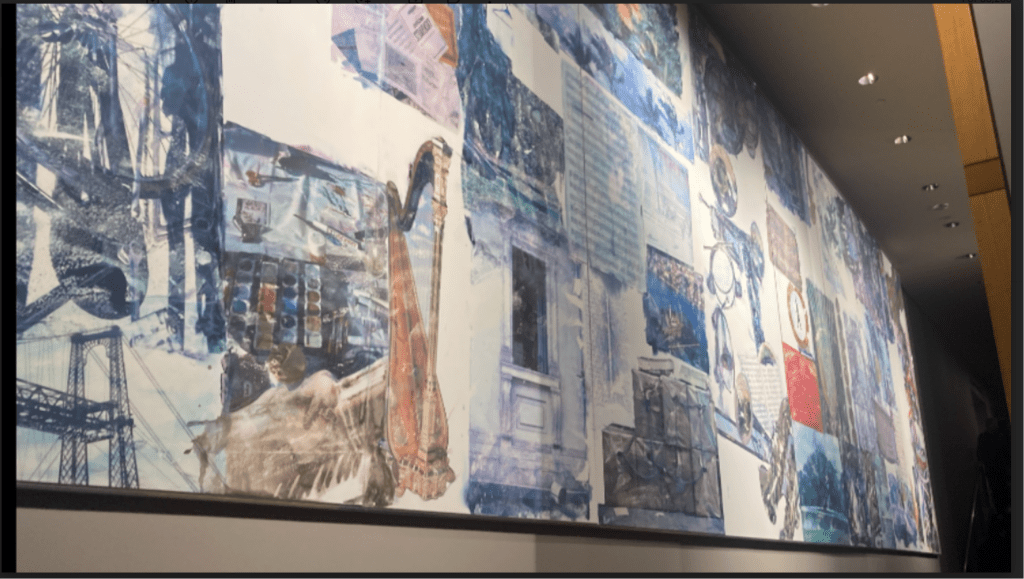
Um – that said — the “danceable 7th” does not really come through in the Widmann piece! Only in blurts and starts and stops and starts does one get a feel that Beethoven is somewhere in the mix. This pomo “deconstruction” is all cut-and-paste, like a Bill Burroughs book. (If you walked by and noticed the incredibly huge assemblage artwork by Robert Rauschenberg that hangs in Benaroya Hall’s lobby as you first go up the grand stairway, you were preparing yourself for “Con brio” whether you knew it or not! Really, in a way, for the whole variegated evening.)
Aleotoric methods are used in his composition. Extended techniques of scraping the sides of wooden string instruments with bows, of wind instrumentalists blowing through their instruments to create more of a sound of a gust of wind, or other musicians suction-cupping their brass instruments, etc, all in between strange whisps of Beethoven, amidst all sorts of other styles (at times even a creepy, Ligetish, textural sort of ‘atmosphere’).
As a whole, the experience is bizarre and wonderful – sometimes even comical — as if we have some sort of discombobulated cognition, listening to Beethoven after we’ve had a stroke – or perhaps traveling back to Vienna via some advanced Elon Musk brain-chip-time-machine gone wrong, part of some Terry Gilliam movie or another…. And then — the piece, just, sort of, ends. Like an Eddie Izzard routine — “So that’s the end of my show. And I do like to end my show with a kind of, … “Oh.”-feeling. … And I think I’ve done that quite well. Hope you enjoyed it.” (We did!)
Emperor Concerto
The imaginative and variegated quality of tonight’s program is truly appreciated. This is the type of evening with which a symphony should create a larger and larger subscriber-base, if there’s any sense to the world. Three completely different styles, a little something for everyone, tied together with a theme. Tonight, the theme was Germans, and heroes. While the contemporary German composer, Widmann, wrote his “Con brio” in honor of his hero, Beethoven, Ludwig himself wrote the 5th piano concerto around the time of the Napoleonic wars, and thus it is filled with heroic feelings and moments. Richard Strauss ends the night with one of his lesser-performed tone poems, Ein Heldenleben (which, again, means, “A Hero’s Life”). He even composed it while being inspired by Beethoven’s 3rd symphony, the “Eroica.” (AH! Nicely done – turns out Widmann’s piece IS an Overture to a full night of Beethoven, in a way….)
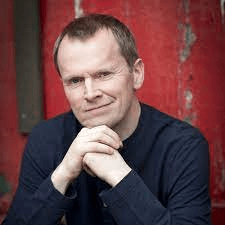
Conductor Edusei comes out on stage with pianist Steven Osborne, our featured (Scottish) pianist. And, as with the “Con brio” before — and the Struass, to come – get ready. Because the SECOND Edusei steps on a podium, he starts. Bam! It’s like the floor of that thing is an on-off switch, or something. No pause, no waiting, no hesitation. Down to business. And of course, like this conductor, who jumps RIGHT into his pieces, this concerto has the pianist jumping RIGHT into the cadenza from the get-go, which is famously revolutionary, for its time.
Heroic? Definitely. The first movement could almost be described as bombastic with the forceful dynamics and cadenzas, composed during the Napoleonic wars – sounding like the French cannonballs falling on Vienna, as Beethoven hid in his brother’s basement. (I have money on this being Liberace’s favorite Beethoven piece!)
Our pianist looks stern and serious as he plays, not much facial emoting of the beauty that is pouring out through his fingertips. (Which is fine – sometimes it can make me uncomfortable seeing an artist essentially have an orgasm out there in front of us, swaying all over the place while playing…. I mean … euuu, get a room!) Osborne’s performative style is to let the fingers do the talking.
When things really get rocking in the movement, his FF style is to REALLY attack and pound the keys. The effort made is great. One can really see it, as well as hear it. And stylistically, I do enjoy the way Osborne “throws back” that hot potato/music to the conductor after a solo section, with an exclamation point with his arms off the keys – solo OVER – and a turn of the head back to the symphony – “alright, guys – back to you!”
We all want these performances to be perfect. But alas, as another Scot said, “The best laid schemes o’ mice an’ men gang aft a-gley.” However, while Osborne made the occasional mistake of a note here or there, you know … “To play a wrong note is insignificant; to play without passion is inexcusable,” and all. And Osborne’s music from that concert grand was absolutely passionate and heartfelt. He is not from the András Schiff school, where the performer has a sworn duty to uphold the composer’s writing like it was some goddamn Constitution or Bible. He is an advocate for performers’ “license to express,” via a composer’s work. As he says in one of the YouTube videos he’s featured in (in an adorable actors-who-play-Hobbits accent!): “If you’re not actually bringing something that has depth and commitment and passion, then what are you doing on the stage?!”
So true — especially when he gets to (without hyperbole) one of the most beautiful pieces of music ever written, the 2nd movement, the Adagio. Still with the stern face (likely how Beethoven himself performed), but, oh, the music! So-so-so-sublime. The slow, sweet trickle downward of the notes contrasting pointedly with the first movement’s show-offy cadenzas, in terms of form (tempo and dynamics and feel) – but this movement could stand alone. There are few things that take one to such a height of trance of beauty.
Ludwig was such a repressed macho man. He’s famous for the quote, “Music should strike fire from the heart of man and bring tears from the eyes of woman.” But if this movement brings forth tears to you – and you’re a ‘man’ – it’s not because “you’re not a real man.” It’s because you’re a human being. You have the capacity for love and sweetness and yearning and something so deep inside you that you don’t know if it could ever come out, but somehow this piece reaches in and pulls it from you…. So sad, that our beloved composer, blatantly capable of such gentleness and beauty, from this, to the Pathetique’s 2nd movement, to the Pastorale symphony, and on and on, had to live in a world where his genius ability at expressing “non-binary” emotions — “male” AND “female” emotions, etc, whatever that really means — so effortlessly and flawlessly, had to go and be obviously repressed from being open and honest about that ability. (Yay, for the coming of the likes of Klaus Nomi to the German spirit!)
The piece ends with the fanfare of the 3rd movement, and by the end, all on the stage received a well-earned standing-ovation from the Seattle audience. Of course, Seattle gives standing ovations to just about EVERYTHING, so they don’t mean much – a symptom typical for the land of the “Seattle freeze.” But at the rousing end of the concerto – everyone was ON THEIR FEET. Like, I’m talking, in 1-2 seconds, everyone was cheering loudly, uncontrollably, and on their feet. It was much more sincere and earnest and … again, well-earned in my opinion. (Perhaps that is how we, in Seattle, can truly measure whether we cold, dark, reserved Pac-Northwesterners like something or not? Not based on standing ovations, or curtain calls, but on seconds it takes from the end of a show to the standing ovation? If it’s a “ten-to-fifteen seconder,” well, you know, that’s an average time-to-standing-ovation (TTSO), so, about a B-. This Beethoven performance, however? It earned the rare and prestigious “one-to-two-seconder TTSO!”)
Oh! Also, Mr. Osborne gave us an encore! (I love encores! Like a chef giving you a little freebie!) Unfortunately, I cannot tell you what it was. It was a sweet, gentle, simple little piece. Sounded full of Americana. Something lullaby-ish. A folksy Americana lullaby, with a simple, gentle melody and chord progression. I wonder if Mr. Osborne composed this himself? (If anyone knows, please comment!) It was an endearing, melancholic farewell from our Scotsman. Safe travels, Sir!
Ein Heldenleben
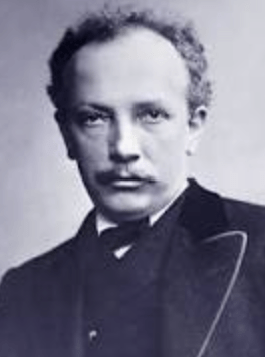
Richard Strauss closes our night with “Ein Heldenleben”, his 1898 tone poem. Though he said it was abstract, there is evidence it was autobiographical. (The seemingly egomaniacal Strauss implied later, why shouldn’t it be about himself? He claimed he was no less interesting than Napoleon! Although … I’m not sure if that was off-the-cuff, perhaps in the same vein as Lennon’s “we’re more famous than Jesus, right now.”)
The piece contains quotes from previous Strauss works, from Zarathustra, Don Juan, Don Quixote…. Heck, the third section – “The Hero’s Companion” — was based on his wife – so, seems pretty autobiographical! Strauss, while staying in a Bavarian mountain resort, and being inspired by Beethoven’s Eroica, uses horns for heroism. As well as for his adversaries. Like Wagner, he employs leitmotifs. (The ‘Hero’s Enemies’ even has a Jaws feel to it!)
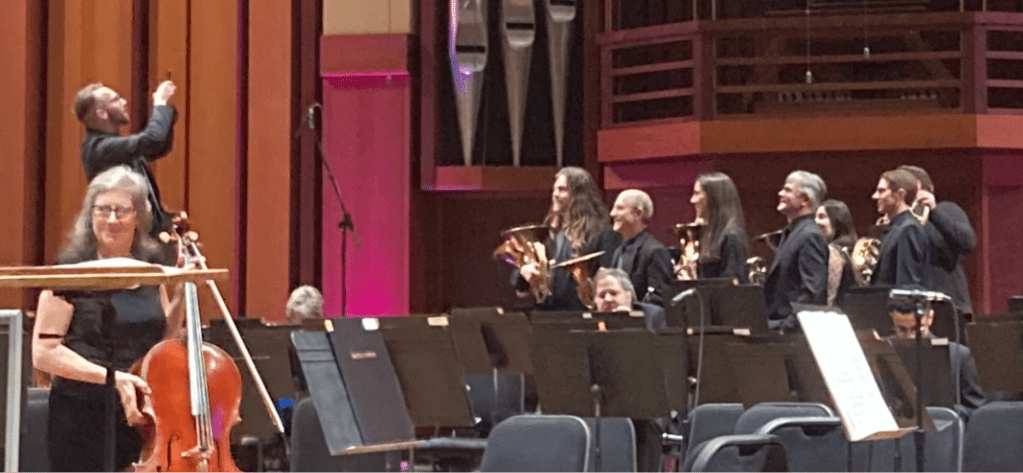
I loved the placing of the trumpets – playing a theme off-stage, just behind the large swinging doors up stage left. I knew the sound was muffled, and could not see who was playing, and it all made sense once our trio came scurrying back to their seats like sneaky little mice….
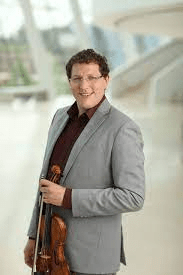
Man, First Violinist and Concertmaster, Noah Geller, REALLY shined tonight! He did such an amazing job with very difficult solos for the violin for his solo, representing “the hero’s companion,” which again, was really Strauss’ wife, for inspiration. Beautiful, polyphonic, fast, hitting the whole range of the instrument, from lowest to highest notes, from loud to holding a delicate pianissimo for an extended period. Just absolutely perfect to this ear. I’m blown away by his successful virtuosity tonight.
Mr. Geller, we know, is a big guy. Kinda intimidating seeing him up there, cuz he looks like he could knock your block off. And then he goes and plays this supremely gentle, sweet solo, so effortlessly?! (I wish my Gen Z kids came with me – there’s all this non-binary stuff going on all over the place tonight! Lol.)
Strauss, despite breaking the boundaries in his day, with his increasingly chromatic compositions, did not quite break out altogether like Schoenberg, and always sounds to me like – and I know this is with a 20-20-hindsight-Monday-quarterback perspective – just sounds too rooted in the late 19th century of Wagner. Wagner was like a quicksand that other Germans just couldn’t escape. If you wanted something different you had to go to a French salon.
In fact, most of this tone poem could be mistaken for Wagner on a quick first-listen. Or just the kind of Romanticism that the populist John Williams adores. The horns throughout the piece could easily have been stolen for his Darth Vader theme over here, or the ceremonial scene at the end of the original Star Wars, over there.
By the end of this piece and the night, another standing ovation. And another well-earned 1-to-2 seconder TTSO, at that — I think mainly for Noah Geller. Edusei rightfully gave credit to other groups of musicians, notably the horns, as well — always so hidden, back there (unless you’re in the balcony….).
Overall, another great night at Benaroya Hall. A geniusly tied together, heroic program, that was kinda all over the place – in a beautifully, logically organized manner. Das ist gut, yo.
S.E. Barcus is also on Facebook.
 S.E. Barcus
Leave a comment