Review by S.E. Barcus
Mother Russia, By Lauren Yee
Seattle Rep, March 6 to April 13, 2025
Review of World Premiere Opening Night, March 12, 2025
(**Spoiler alert – some of the funnier jokes, and the surprise ending, are spoiled herein!!**)
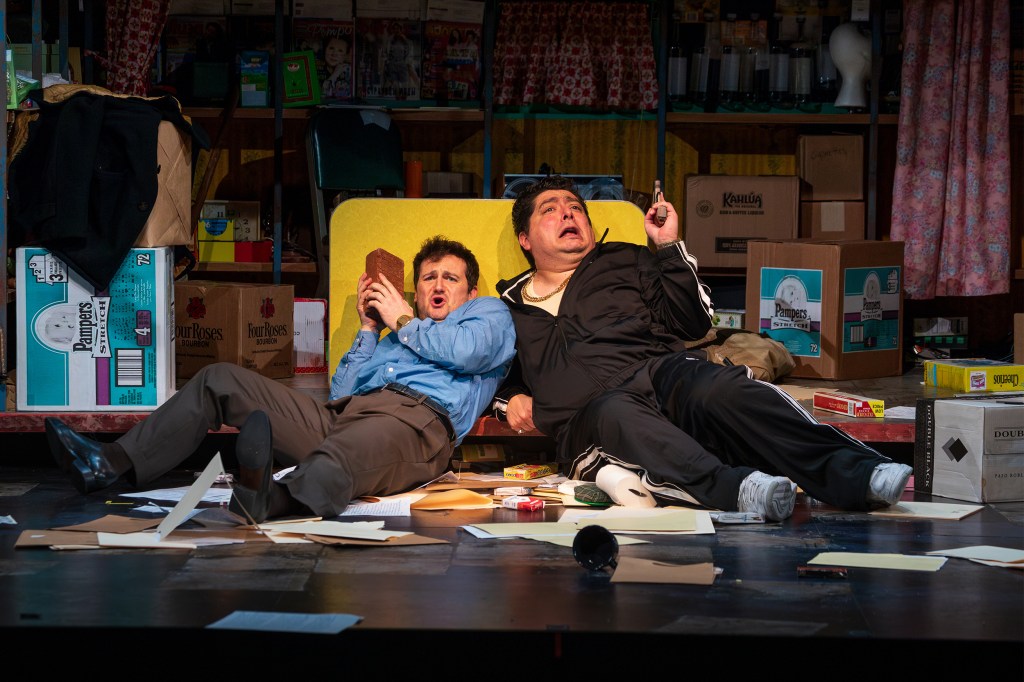
Lauren Yee’s world premiere play, Mother Russia, opened at Seattle Rep Wednesday, March 12, 2025. It is a comedy about two Russian friends, set in 1992, just after the breakup and attempted democratization of the old Soviet Union. One of them, Evgeny, is the son of an old Soviet KGB administrator, part of the elite bureaucratic class, the “nomenklatura”. The other, Dmitri, is a sort-of “gopnik” – a more lovable common man, more working class, then and now (like, Papageno to Evgeny’s Prince Tamino, to allude to the incredible opera production that just closed down the street…). These two had planned on being happy Soviet cogs, but are now confused by their new unregulated free-for-all capitalist reality, all mixed in with a romantic comedy. Basically – a fish out of water story, where the water was Soviet Communism. It is almost entirely light fare (until the very, very end) and comments in a carefree manner on this chosen political backdrop. And … oh yes, it opened smack dab in the middle of the ongoing, naked, all-out assault on our democracy, by a leader who is de facto in collusion with the current repressive Russian autocrat.
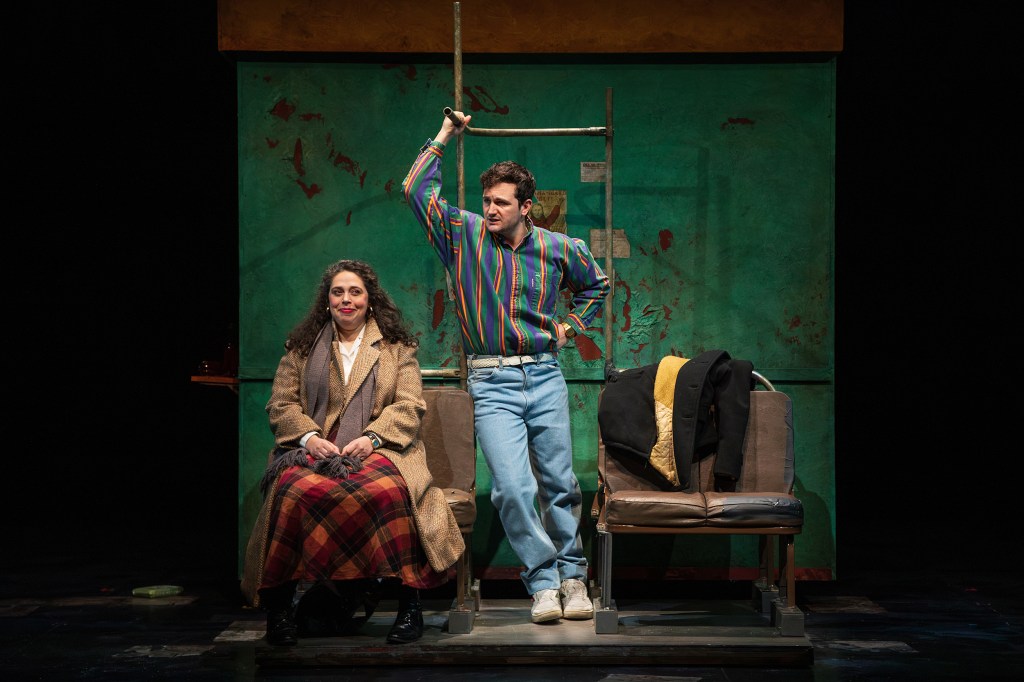
For what it is, the comedic writing is decent enough, even if, at times, not very subtle (e.g., exposition in your face: “hey, here we are, we’re 25 years old and it’s 1992!”). There’s your screwball-type love affair, woven into farcical misunderstandings, mistaken identities, and verbal faux pas. Actor Billy Finn has several funny lines as Evgeny, with his many slips of the tongue. Actress Andi Alhadeff, in her somewhat rote presentation as Katya, would say one thing, and Evgeny would blurt out a response, at first forgetfully lovestruck and honest, but then quickly recover back into his duplicitous self, implying that he meant something completely different. (This Freudian slip technique was used perhaps one too many times, however.)
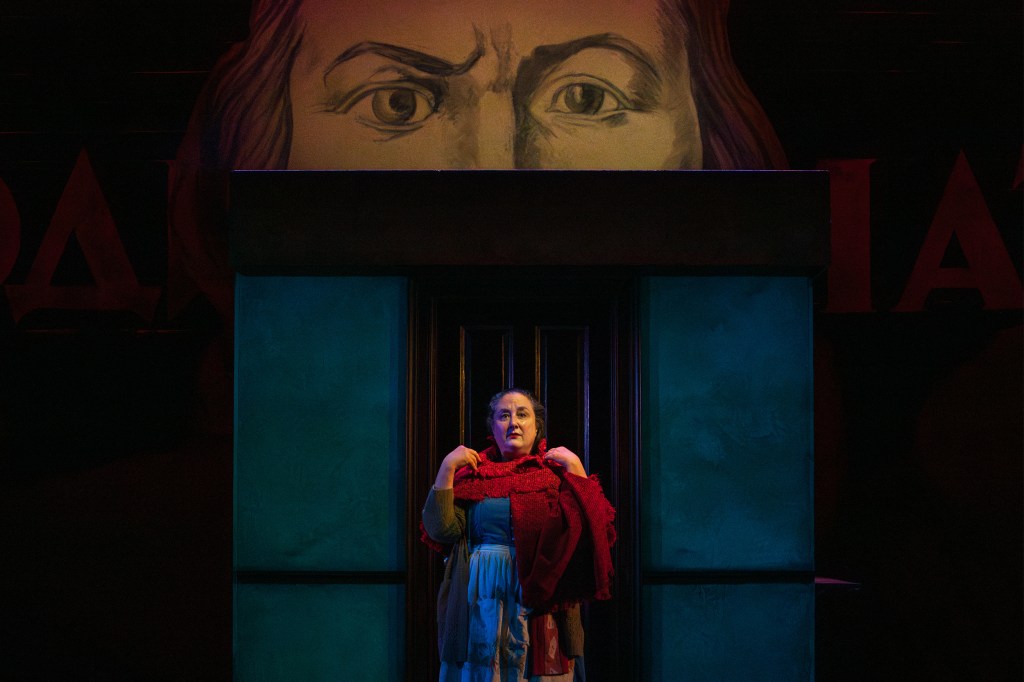
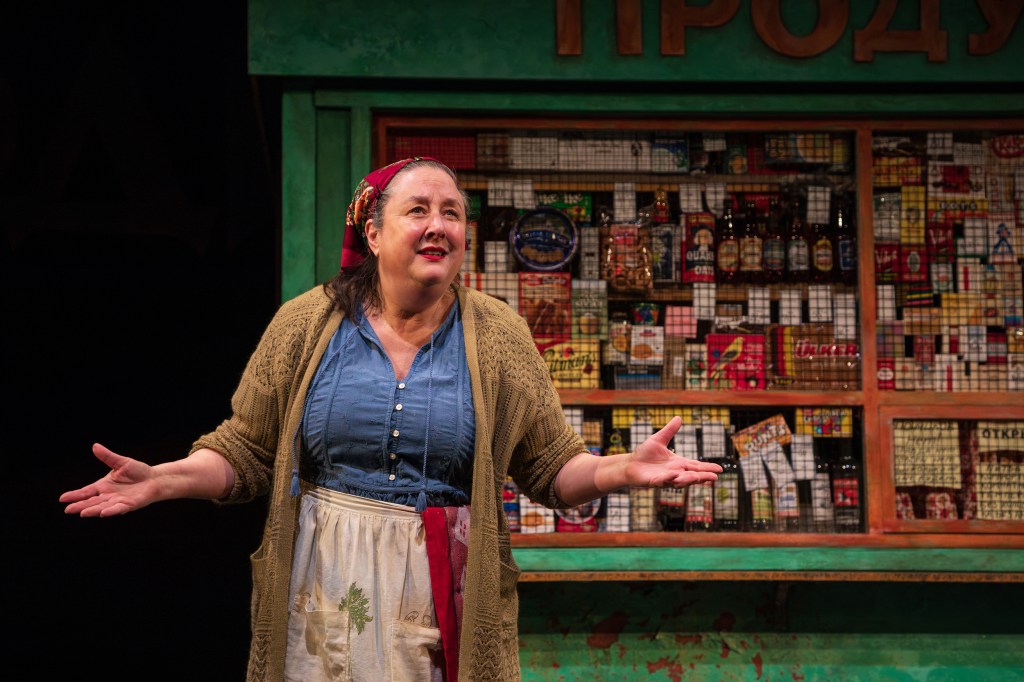
Throughout, our metaphorical character, Mother Russia, played with a dry wit by Julie Briskman, intercedes humorous commentary about the play, and also Russia. She perceives the trappings of this new consumerism, as she notes that since the fall, there are a plethora of choices, like all the new, different couches in the showrooms to choose from. But that, even if she chooses a really good couch, she’ll still always wonder if maybe she should have chosen one of the others. Which she feels might be causing more harm than good, as now her people always want more, whereas before, “we were happy we even had one couch.” Overall, the past czars and premiers have all come and gone, disappointing her. She sees Russia as an eternally-fated imperialist nation, as someone from the Foreign Policy journal might write, except – this seemingly innocent Mother Russia seems, overall, to be ok with this predicament. “Gorby, for real? If you let them leave, the rest will follow, and the family will all break up.”
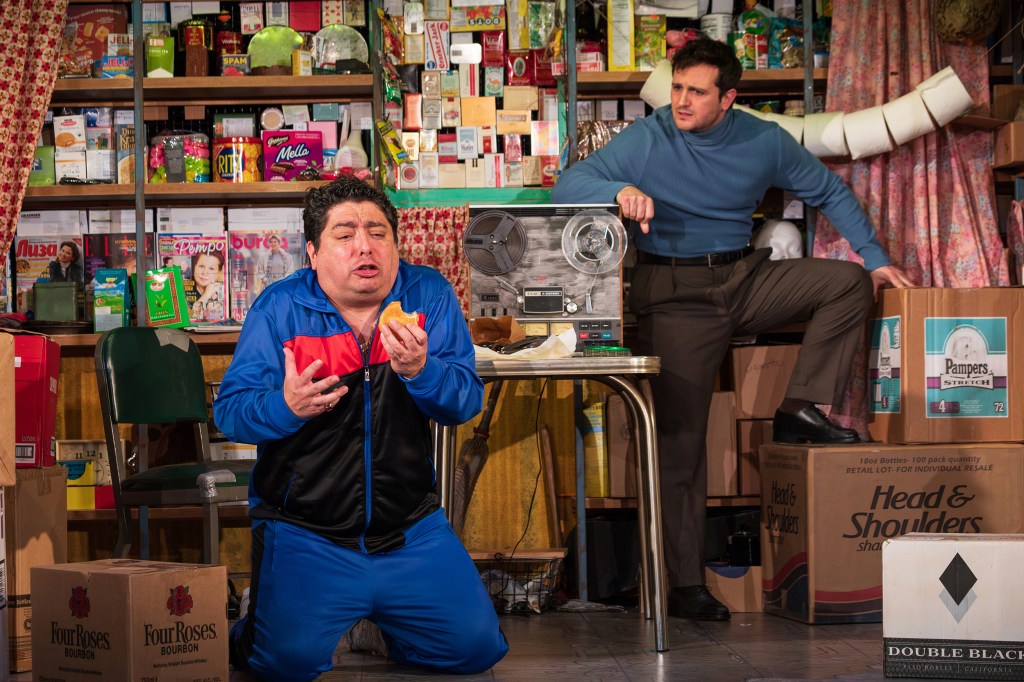
I laughed out loud several times, such as when the past dissident-singer Katya is reduced to – and ecstatic with – a potential gig singing commercials for Folger’s coffee, in a very gritty Sonic Youth manner. But more often than not, the laughter comes thanks to the excellent comedic performances of Jesse Calixto, as Dmitri, and Briskman. Calixto is adorable as he bemoans not being guaranteed a communist job that he could never be fired from, whether or not he was drunk and incompetent (and he admits he was definitely looking forward to being drunk and incompetent!). Or as he tries to wrap his head around Adam Smith’s “invisible hand,” or salivates all over American fast food. Briskman has the stand-up comedian’s advantage of direct interaction with the audience, where we have no defense from being taken in by her charms (and the donuts that she passes out). For this deadpan Mother Russia – “and her children” – “you can never say anything. You can say, ‘I love you,’ and they say ‘why you love me so much, why you feed me so much, why 50 million dead in land war….’ Ah! There is no winning with them….”

While Yee’s writing is funny enough, Nicholas Avila’s direction was not quite up to farce tempo. And Designer Misha Kachman’s cool, spinning street-market-rich-house-bus-wall swiss-army-knife-like set can’t be blamed for slowing things down — characters could be talking on the side while set changes happened, as they often did. The lines, the repartee – they just weren’t snappy enough. The one time things did zip along nicely was at the end, when everything was hitting the fan, and the hilarious Calixto yelled his realization at Evgeny’s mistaken identity, perfectly comedically timed.
If it weren’t for the chosen focus on the backdrop, and the current context, overall, I’d give the play a “B,” and say that if you want a divertissement from the current horror – (and have 100 bucks to spend on it) — then go ahead and see the play. But Russia IS the focus, and the backdrop. And what timing! First, like the Academy Award winner just earlier this month, Anora, we have: screwball comedy, with a Russian backdrop; a tryst between a poor woman and an oligarch’s son; and a lovable gopnik. And I friggin loved Anora. But that film kept the backdrop a backdrop, and instead focused on character, on her struggle and overcoming her personal tragedy. That was the story, and it worked. Sure, there were hints that those oligarchs were sinister, but the movie didn’t feign to be “about” Russia.
But Mother Russia? With the titular character constantly adding commentary about how the context of the farce is in and about the world of Russia, and past repressions, the nascent up-and-coming murderous oligarchs? This play desperately wanted to have its cake and eat it too; to be politically meaningful, while still being silly. But unlike, say, the actual Mother Courage, or another Russian-American themed farce, Dr. Strangelove — both of which pulled off that seemingly impossible cake paradox perfectly — this play was more like a shockingly uninformed Marie Antoinette flippantly telling us to just go eat it. Or … donuts, in this case.
The play wants to “mean” something so badly that it does the worst chain-yank-genre-shift I can remember. Evgeny, throughout, is a bumbling, okily-dokily, sweet guy. Period. And the play, throughout, is a light farce. Period. Ok, that’s what the piece is, fine. Then, suddenly – at the very, very end – Evgeny is the type of guy who will casually have his best friend murdered – his best friend who helps him, who bakes him banana bread, fer chrissakes?! (Tamino! How could you?!) And all just so he can finally please his oligarch daddy and get his own football team?! Ok, if so, that would be a heavy, psychological idea, a serious betrayal, and even symbolically accurate to what Putin has done to his people — but it sure as hell would need more background than just seeing a mopey unloved kid outside his dad’s door! Or a kid who — egads! — made his friend chew used gum! These do not suggest sociopath, which is how he was coyly played at the end as he sent his friend off to die. And so — at the very, very end — the play suddenly turns thematically dark, with red lighting and creepy sound effects, and Mother Russia wraps it all up, along with her nice red shawl, by deciding she’ll go with some Putin-type figure, while a “Western pop culture” version of Tchaikovsky’s evil magician theme from Swan Lake plays us out.
Sorry, you cannot turn a lovable hero into a psychopath at the very, very end with no character development to that end. And you cannot genre-shift at the very, very end of a play. Genre-shifts can be funny and interesting, as a technique, as shown by Hot Fuzz, for example. But to do one genre for 89 minutes … and then end a play in a very serious dramatic type genre, in just 1 minute?! That’s not technique. That’s called “tacked on”. Perhaps a last minute attempt to make the play relevant, when most of the play was so obviously conceived before February, 2022, or January, 2025? But it feels cheap. And on top of that, because it professes to be profound, it makes the whole play feel cringey. Imagine Tony Curtis letting his buddy Jack Lemmon get whacked by the Chicago gangsters at the very, very end of Some Like It Hot. You’d be left with: “uh … wtf?”
Why would an Artistic Director produce this show, right now? It must have been accepted in the midst of the Ukraine war. One must have known Trump might win the election. This seems like a crass grab for a world premiere by “one of our country’s most produced playwrights,” as Artistic Director Damaso Rodriguez crows in his preview notes. A business decision more than an artistic one? Hey, I’m a sucker. Worked on me. But the play is just so supremely tone deaf to the noises in America in March, 2025. It is an excellent lesson in doing the wrong play in the wrong place at the wrong time. On opening night, Rodriguez commented that tonight was the 5th year anniversary of closing the Rep due to Covid, to the day, and that, “We wanted to mark the moment, but also look ahead. … And you know, this play is actually about periods of great transformation, and so it’s appropriate that this play is happening tonight. It just feels right.” Sooo…. The “great transformation” going on in the play — about Russia, and a society being slowly turned into a murderous oligarchic libertarian capitalist one –- should obviously remind us all, right NOW, of … Covid?!
Look, give Russia ten years to get rid of Putin and become decent neighbors and citizens within the world again (and at this point, we’re gonna have to do that here, too). Give Russia ten years to finally overcome Pyotr Chaadaev’s complaint that his country “represents nothing more than a gap in the rational existence of humanity” (as Designer Kachman, who grew up in St. Petersburg, pointed out), and become its own decent democracy on Earth that serves its own people rather than treat them as fodder for its war-crime-ridden, murderous, revanchist campaigns against its democratic neighbors that explicitly target civilians – THEN maybe you can dust this silly 2017 play looking at 1992 Russia and produce it in one of America’s premier regional theaters. (I mean — I don’t think anyone thought of the word “defenestration” so much since the Thirty Years’ War! Today — it’s a punchline we use to describe Putin’s politics. That, and “polonium”.)

And if you are a lucky, hot playwright, who can get paid to get the wrong farce produced at the wrong time? Then, well … first, obviously take the money! 🙂 But, hey, YOU’RE the playwright. This is YOUR expression at THIS time. Live theater – more than film or visual art or classical music or almost any other art form – is a contemporaneous art form. It is literally alive in front of you. To not truly leverage our most unique and powerful attribute is a shameful waste. “Museum pieces” and meaningless pieces to the present – these are what bring about “the death of theater.” To not acknowledge your audience and context — those people paying and watching, who likely have real apprehension about what is going on in the world, right NOW, and are coming out, communally, desperate for a shared artistic experience that speaks to it?! To do a play directly using a topic (the beginning days of a frightening oligarchy) and directly referring to a country (Russia) that are both intimately related to the current political catastrophe we are all going through in the United States right now, and not, somehow, speak to it?! Unless … you want us to make that stretch for you? Or, perhaps, I dunno, Director Avila could have hit us over the head with some Trumpy allusions? But none of that was in here. None of that was even conceived of nor intended, the best I can tell, based on this production, and the interview with Playwright Yee in the program. This is a 2017 farce about Russia and its transformation in 1992. Fine. Shelve it for that hopeful 10-years-from-now-utopia. Because nothing in here was meant for us TODAY.
Imagine if Arthur Miller, writing The Crucible in the 1940’s as a raucous comedy, was asked by someone in the 1950’s McCarthy-era if they could produce the play, and neither the producer, writer, nor director thought to change anything about the comedy’s themes to somehow comment on the obvious — the current paranoia and hysteria and persecution? … To skirt around the destructive GOP-elephant in the room, that was tromping around in there with us on opening night, in real time, while watching this play, is art that is either uninformed or lazy or cowardly or in collusion. Sorry. Pains me to say that, when American theater is struggling so badly, especially when theaters take risks and produce new works. Kudos for that, and please keep doing that, Rep. But, for all the decent theatrical artistry in this production — and there is plenty of it — and for all the sweet donuts handed out, I’m so sorry, but I truly left with a bad taste in my mouth.
Copyright March 12, 2025
 S.E. Barcus
Leave a comment