
Age and Sex Trends of Contemporary Classical Music Composers, Using Current Popularity Data
Barcus, S.E.; Dowding, M.
Journal of Musica et Ineptias, Vol. 1, Iss. 1, p. 1-14.
Copyright Dec 4, 2024
ABSTRACT
Objective:
To determine which groups of contemporary classical music (CCM) composers were more popular amongst avid consumers of CCM: alive or deceased?; younger or older?; and female or male? Before conducting the study, it was suspected/hypothesized that it would confirm what is assumed by many, anecdotally: that deceased and/or older composers would likely be more popular than living and younger ones, and that the data would suggest a trend — since women’s rights have advanced globally, in general, since 1945 (at least until the recent autocratic misogynistic reactionary backlash of the past 10 years…) — that there would likely be a statistically significant increase in both the representation and popularity of female composers over the past eight decades.
Methods:
This survey occurred during the week of Nov 25, 2024 through Dec 1, 2024, on the social media platform, Facebook™, querying members of the esteemed and very active private group, “Contemporary Classical Music.” As of Dec 1, 2024, this group contained 82.7K members from around the world, many of whom actively work within the contemporary classical music field themselves, as composers, musicians, professors, bloggers, reporters, and/or are just plain serious afficionados. Participants of the survey acted spontaneously, not knowing they would be part of this research.
The survey used the definition of “CCM” as defined by the moderator(s) of that group: “The focus of this group is music in the Western Classical Tradition composed after 1945 (or so).” Member and Co-Author M. Dowding queried the group, asking them, “Who would you say your 10 favourite contemporary classical music composers were?” (Fig. 6, below.)
Part A: Responses were tallied, with each composer mentioned getting one “vote,” and an overall individual ranking of popularity was produced (Fig 1, below). Despite several members choosing to give less than or more than the requested 10 names, any/all names that were mentioned were accepted for the purposes of this paper.
Part B: After the total ranking, composers were then categorized as “female” or “male,” (based on gender pronouns found in Google™ searches), and compared as to average votes-per-composer within each group, with higher average votes being deemed more “popular” (Fig. 3a, below)
Part C: Then, the total tally was categorized as either “living” or “deceased” (given the frequent debate amongst members of the group, that “contemporary” should be re-defined as “living”), and compared as to average votes-per-composer within each group, to once again determine which of the two groups was more “popular” (Fig. 2, below). These two sub-groups (“living” or “deceased”) were then themselves similarly sub-categorized as “female” or “male,” and compared as to average votes-per-composer. Note was made as to how “female” representation and popularity were trending (Figs. 3a and 3b, below).
Part D: Then, the total “living” tally, above, was taken and sub-categorized into “younger” or “older” groups, comparing these two as to average votes-per-composer within each group. “Younger” was arbitrarily defined as “younger than 60.” Then, these two sub-groups (“younger” or “older”) were similarly sub-categorized into “female” or “male” groups, and compared as to average votes-per-composer. Note was again made as to how “female” representation and popularity were trending.
Results:
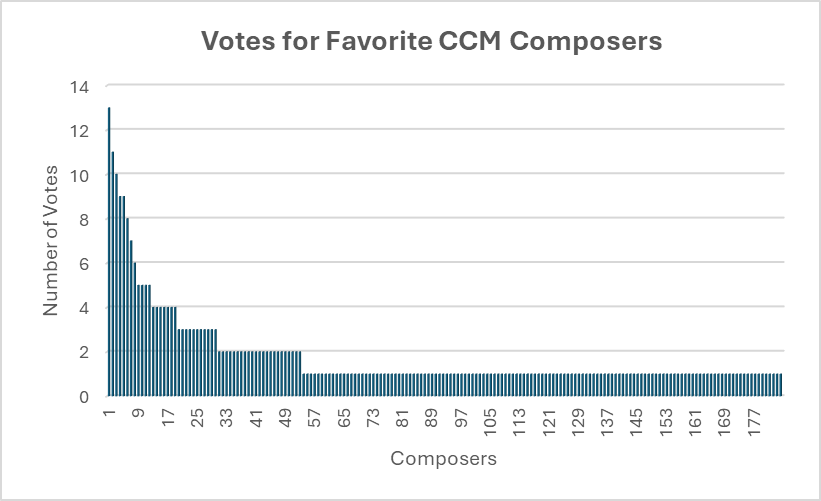
Part A: There were 103 responses total (many of which were sub-comments within a members’ vote/comment). The total number of votes was 331, which could correlate to about 33 participants of the survey, give-or-take. A total of 184 different composers were named by the participants, overall, with votes ranging from 1 to 13 votes for each composer, with the average overall vote per composer being 1.80. The median was one vote, with a majority of the list, 131 of the composers voted upon (73.37%) only getting one vote, and the other 53 composers (28.80%) receiving more than one vote (Fig. 1, below).
Part B: Overall, of the total of 181 composers whose age and sex could be verified via Google™ search, 31 were women, or 17.12% (average 1.35 votes per composer), while 150 were men, or 82.87%, (average 1.91 votes per composer), a difference in popularity, on average, of 0.56 votes in favor of men, overall (Fig. 3b.).
Part C: Of the 181 composers, 120 of the composers were alive, or 66.30%, (average 1.42 votes per composer), while 61 were deceased, or 33.70% (averaging 2.59 votes per composer), for a difference of 1.17 more votes for the deceased composers, on average, overall (Fig. 2.). … Of the total 120 living composers, 28 were women (23.33%), (average 1.48 votes per composer), while 92 were men, or 76.67%, (average 1.43 votes per composer), a difference in popularity, on average, of 0.05 votes in favor of women, in the living composer sub-group (Fig. 3b.). … Of the 61 total deceased composers, only 3 were women (4.92%) (average 1.33 votes per composer), while 58 were men, or 95.08%, (average 2.66 votes per composer), a difference in popularity, on average, of 1.33 votes in favor of men, overall.
Part D: Dividing the 118 living composers whose age could be verified by Google™ search (arbitrarily younger or older than 60), there were 55 (46.61%) who were younger than age 60 (averaging 1.2 votes per composer), and 63 composers (53.39%) who were older than 60 (averaging 1.62 votes per composer), a difference in popularity, on average, of 0.42 votes in favor of older living composers (an improvement from the 1.17 votes that was in favor of the deceased composer, above). Fig. 2, below. … Of the 55 younger composers, 19 were women (34.55%), the most representation for women in any category (Fig. 3a) (average 1.26 votes per composer), while 36 were men, or 65.45%, (average 1.17 votes per composer), a difference in popularity, on average, of 0.09 votes in favor of women, in this “younger living composers” sub-group (Fig. 3b). … Of the 63 total older composers, 9 were women (14.29%) (average 1.56 votes per composer), while 54 were men, or 85.71%, (average 1.63 votes per composer), a difference in popularity, on average, of 0.07 votes in favor of men, in the “older living composer” sub-group (Fig. 3b).
Conclusion:
This study determined which contemporary classical music (CCM) composers were more popular amongst avid consumers of CCM, when categorized as either: alive or deceased; young or old; and female or male. The working hypothesis was confirmed: deceased and/or older composers are overall more popular than their living and younger counterparts, much of which is likely due to fairly obvious reasons reviewed in the discussion; and trends in the data suggest that, since 1945, there have been significant advances in both the representation and popularity of female composers, which can only be seen as an encouraging sign for the future of music, as well as to the progress of our species, continually striving for greater Enlightenment. The arc of history, and such.
Discussion:
While the overall conclusions are not too surprising, arguably landing this research into the “no shit, Sherlock” file of scientific inquiry (a quite large file), the overall skew of the total vote, shown below in Fig. 1, is quite striking, showing that there is as much an “oligarchy” to popular CCM composers as there is to wealth inequality in the world today (see Piketty, et al). Three composers (Ligeti, Stockhausen, and Xenakis) — make up “the top 1%” of the composer list — hoarding 10% of the total votes cast for themselves (garnering 34 votes out of the 331 total), while the 1-vote composers are all equal and tied in the bottom 73.37% (131 composers), having to share 40% of the votes (131 out of 331 total) amongst themselves. (It makes one sympathetic to those classical music hooligans and their “Occupy Darmstadt!” movement….)
The reason for this, as similarly discussed within the original FB post’s query comments, might be due to the fact that “history” – in general – might be “sifting” out the truly great artists. (Imagine how even MORE unequal the “oligarchy” would be if one queried the whole Earth about “greatest composers,” in general, and how skewed it would be toward Bach, Mozart, and Ludwig, etc….) If we were to presume there might be only one truly great, new, revolutionary, inspiring, genius, etc etc composer about every year, or every 5-10 years, or whathaveyou, then we would have to conclude that these composers were tested, by multiple generations, and survived that test of time, against multiple different zeitgeist’s criticisms. Why are these older artists better known (i.e, “more popular”)? They have been “verified.” They have been “vetted.” Thus, if one has a ‘great artist’ every year, since 1945? Simple math shows that would equal quite a few more who are deceased and older over who are alive and younger.
Also, our forebears have another advantage. We are currently living in what John Cage called “not of mainstream but of many streams … or even, if you insist upon a river of time, then we have come to the delta, maybe even beyond a delta to an ocean which is going back to the skies….” With this has come the death of the “style wars,” which made art into ‘political movements’ with ‘leaders’ – leaders who often (just coincidentally, mind you!) went on to seize for themselves the status as the ‘greatest’ of their particular ‘movement’. Living and younger artists also have the disadvantage of exponential global population growth over the past 100 years (going from 2 billion people to 8 billion), as well as the globalization of arts, like all culture, in general (not nearly as Eurocentric) in our Information Age, with our access to ‘everything everywhere all at once’…. Thus, statistically we probably have 10, maybe 100, maybe 1000 “geniuses” for every one we had in the 1940s? But they are like needles in haystacks now, and if there are hundreds or thousands of them, they also just don’t “seem” as “special” or revolutionary as they might have back when there was just one little weirdo named Mozart or Ligeti running around…?
As can be seen in the overall raw data below (Fig. 5), the top 10% of most popular composers (19 total), were as follows, in rank-order: Ligeti (13 votes), Stockhausen (11), Xenakis (10), Boulez, Messiaen (tied for 9), Feldman (8), Reich* (7), Dutilleux (6), John Adams*, Berio, Lutoslawski, Penderecki (tied for 5), Aho, Cage, Carter, Ferneyhough*, Pärt*, Riley*, and Takemitsu (tied for 4). To inform our discussion as to what it means to be “contemporary,” we note that only six of the 19 (31.58%) most popular overall composers are living (with asterisk); average age 83. We also note that none are women.
We note that while “60 years old” was somewhat arbitrarily used to define “younger” and “older,” it seems to have been a good pick, given it very nearly neatly cut the group of living composers exactly in half.
Meanwhile, the most popular female CCM composers, tied for 3 votes each, were Unsuk Chin, Sofia Gubaidulina, and Rebecca Saunders, all still alive, average age 71 (a difference of 12 years). If we include the next top 5 women (Clara Ionatta, Mayke Nas, Éliane Radigue, Anna S. Thorvaldsdottir, and Kaija Saariaho, all tied with 2 votes), we get eight women total, only one of whom is (only very recently) deceased (Saariaho), and with an average age of 64 (now, a difference of 19 years).
Of course, a more cynical view might believe that living women are always better represented and more popular than older, deceased women, and that it is history that represses this, as history is “written by the winners.” There have been more men than women teaching in academic settings and writing textbooks and being musical directors over the years, etc, so they might have stamped out the older women and kept the men? We know of no older studies from the 20th century similar to this one that would confirm whether or not the percentages of “younger” women of those “current”/earlier eras were similarly popular, as well. Further research is needed. But we would venture to guess that given the obvious explosion of women in classical music over the past 50 years – obvious to anyone with living memory as to the ‘movers and shakers’ of classical music today vs. who they were in the middle and latter half of the 20th century – these data in this paper almost surely will be proven to demonstrate a positive trend for women in the classical music industry, overall, in the decades to come.
While we chose to analyze the data based on composers’ existential state, age, and/or sex, we encourage others to use the raw data provided to ask further interesting demographic questions within our community, as regards to race, nationality, LGBTQA+ status, urban v. rural, academic v. outsider artist, vegan v. meat-eater, etc, etc…. Go to town, the data are yours!
Members of the FB CCM group are very familiar with the ad nauseum “debates” we have over the definition of “contemporary,” typically whenever a new member joins in. Most members are – to date – satisfied with the somewhat arbitrary definition of post-1945. Obviously, as “contemporary” is not a “movement” in the same way “Baroque” and “Classical” are, but instead is to be taken as “of our time,” it would then have to be changed at SOME point, as the years go by. As of now, when and if that is is at the discretion of the moderator.
Perhaps the term, itself, will one day come to mean “music from about 1945 to about 2017,” (72 years — average lifespan of a human being today), in the same way “Modern” (whose contemporaneous practitioners used their term similarly, thinking of themselves as “contemporary,” in the 1920s) is now known to represent that specific time. “Modern” is hardly “modern,” yes? But if that were to occur, what then of ACTUAL “contemporary” music of the future? A new synonym? Perhaps “Existential Music” or “Recent” or “Present-Day” or “Living” or “Sentient” or “Breathing”…?
Many members feel the term should only apply to “the living” – and even voted explicitly that way on this very survey. Perhaps a new group or sub-group should form, entitled, “Living Composers”? Or perhaps (my vote) we make the group one where the definition of “contemporary” – and what time period it refers to — is always evolving in a standardized manner. We are five-fingered, decimal-system loving creatures. 10 years, 50 years, centuries, millennia – this is how we naturally organize things. I propose (to our esteemed FB moderator, and everyone else) that we start to lump groups of composers into 50-year glumps. “Early” or “first half” of a century lump, and “latter” or “second half” of a century lump, and then “contemporary” is always understood to mean the current 50-year lump we are alive in, plus the previous 50-year lump. This is (currently) in-line with the current CCM group’s definition. “1945, or so” to the present = “contemporary.” I like this because it would always be equal to 51 to 100 years, which is about the lifespan of a person, and thus incorporates many/most “living” artists, but also includes that most recently influential and exciting artists, dead or alive, along with the few flare-ups of younger, geniuses who sadly might have died at a younger age. Thus, “contemporary” for me means about 1950 to now, until we hit 2051, at which point it will mean “2000 to now,” instantly evolving in a standardized manner….
Interestingly, we believe that many of the conclusions of this study — along with the ongoing discussions within the CCM community regarding the increased popularity of older and/or deceased artists, as well as the trends of women in terms of representation and popularity, as well as the debate as to what “contemporary” even means — can likely be found, culturally, within all of the other arts, as well, from theater to dance to visual arts to film and poetry and literature, and on and on…. Similar surveys and research in those disciplines would be interesting if they corroborated this study’s results.
A limitation to the current study is that it has not been carefully assessed by professional statisticians, but rather by a layperson procrastinating to avoid their Board exams, using a social media survey and Excel formulas and basic arithmetic, producing in essence a satire of an erudite musical journal’s publication. Thus, the statistical significance of the entire study is up for debate. Further research is needed.
And, so, to conclude: take heart if you are a female composer. Your popularity has been steadily increasing throughout the past 80 years. And take heart if you are not as popular of a composer. It probably means that you are alive!
Finally – while death and age are valid issues for any study, we do not want the conclusions to lead to any discrimination in the form of ageism. Love and respect everyone, perhaps especially our progenitors! They were often the vanguards that helped to make today’s version of “contemporary” possible. Those living composers on this list, 75 and older, are presented in Fig. 4. If you care about CCM, show them the love, right now! – please go to their performances, send them birthday and holiday cards, follow them on whatever social media they’re on, etc, etc.
Fig. 1. Votes for Favorite Composers
| Total votes = | 331 |
| Median = | 1 |
| Mean / Average = | 1.80 |
| Total composers = | 181 |
Fig. 2. Increased popularity of deceased and older composers.
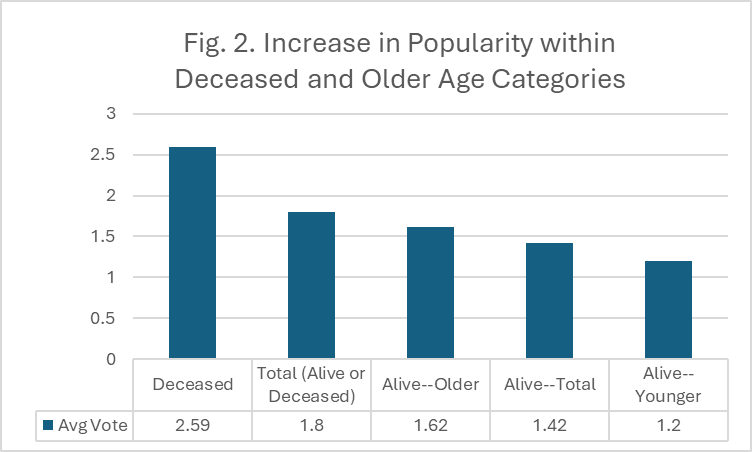
Fig. 3a. Trends, Female Composers — Increase in Representation within Living and Younger Age Categories.
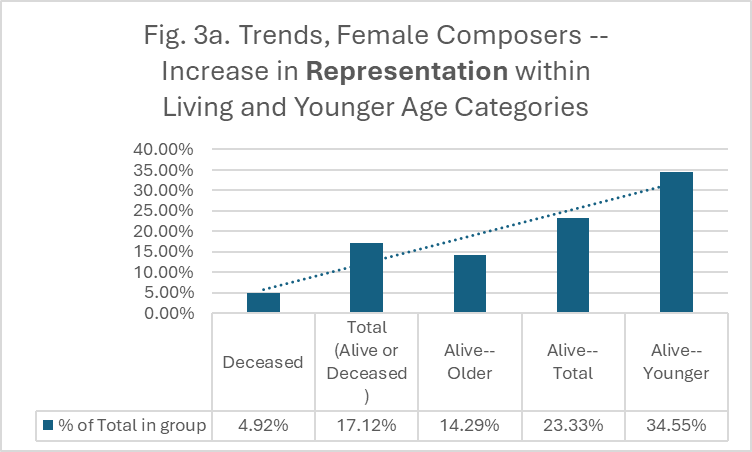
Fig. 3b. Trends, Female Composers — Increase in Popularity within Living and Younger Age Categories
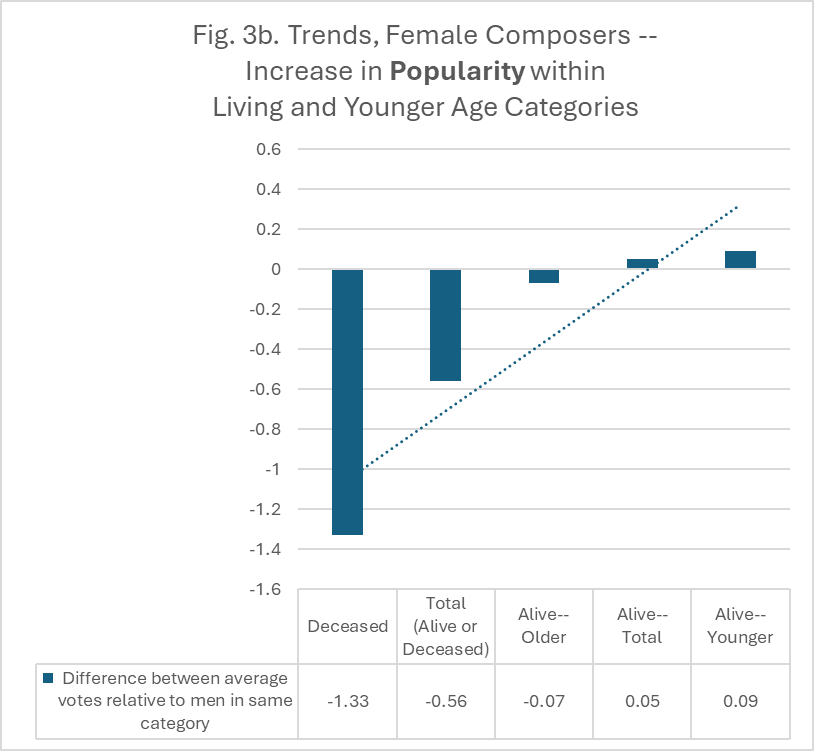
Fig. 4. All Living Composers voted upon, age older than 75.
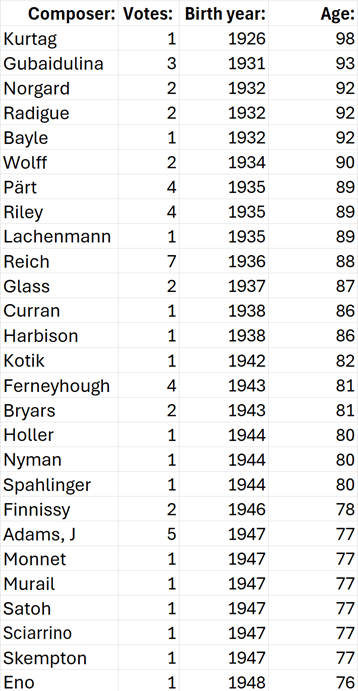
Fig. 5. Raw Data and ranking of all votes and composers, alive or deceased, male or female.
| Alive=1 | Female=1 | Composer | Votes | DOB |
| 0 | 0 | Ligeti | 13 | |
| 0 | 0 | Stockhausen | 11 | |
| 0 | 0 | Xenakis | 10 | |
| 0 | 0 | Boulez | 9 | |
| 0 | 0 | Messiaen | 9 | |
| 0 | 0 | Feldman | 8 | |
| 1 | 0 | Reich | 7 | 1936 |
| 0 | 0 | Dutilleux | 6 | |
| 1 | 0 | Adams, J | 5 | 1947 |
| 0 | 0 | Berio | 5 | |
| 0 | 0 | Lutoslawski | 5 | |
| 0 | 0 | Penderecki | 5 | |
| 1 | 0 | Aho | 4 | 1949 |
| 0 | 0 | Cage | 4 | |
| 0 | 0 | Carter | 4 | |
| 1 | 0 | Ferneyhough | 4 | 1943 |
| 1 | 0 | Pärt | 4 | 1935 |
| 1 | 0 | Riley | 4 | 1935 |
| 0 | 0 | Takemitsu | 4 | |
| 1 | 0 | Adams, JL | 3 | 1953 |
| 1 | 1 | Chin | 3 | 1961 |
| 1 | 1 | Gubaidulina | 3 | 1931 |
| 0 | 0 | Harvey | 3 | |
| 0 | 0 | Henze | 3 | |
| 1 | 0 | Knowles | 3 | <60 |
| 1 | 0 | Lindberg | 3 | 1958 |
| 1 | 0 | Poppe | 3 | 1969 |
| 1 | 0 | Salonen | 3 | 1958 |
| 1 | 1 | Saunders | 3 | 1967 |
| 0 | 0 | Schnittke | 3 | |
| 1 | 0 | Adés | 2 | 1971 |
| 1 | 0 | Anderson | 2 | 1967 |
| 0 | 0 | Andriessen | 2 | |
| 0 | 0 | Babbitt | 2 | |
| 0 | 0 | Baraque | 2 | |
| Alive=1 | Female=1 | Composer | Votes | DOB |
| 0 | 0 | Birtwistle | 2 | |
| 1 | 0 | Bryars | 2 | 1943 |
| 0 | 0 | Crumb | 2 | |
| 1 | 0 | Finnissy | 2 | 1946 |
| 1 | 0 | Glass | 2 | 1937 |
| 1 | 0 | Haas | 2 | 1953 |
| 1 | 1 | Iannotta | 2 | 1983 |
| 0 | 0 | Kapustin | 2 | |
| 0 | 0 | Maderna | 2 | |
| 1 | 1 | Nas | 2 | 1972 |
| 1 | 0 | Norgard | 2 | 1932 |
| 1 | 1 | Radigue | 2 | 1932 |
| 0 | 0 | Rautavaara | 2 | |
| 0 | 0 | Rihm | 2 | |
| 0 | 1 | Saariaho | 2 | |
| 0 | 0 | Stravinsky | 2 | |
| 1 | 1 | Thorvaldsdottir | 2 | 1977 |
| 1 | 0 | Wolff | 2 | 1934 |
| 1 | 0 | Ammann | 1 | 1962 |
| 1 | 0 | Andre | 1 | 1964 |
| 0 | 0 | Arnold | 1 | |
| 1 | 1 | Avramidou | 1 | 1988 |
| 0 | 0 | Badalamenti | 1 | |
| 1 | 0 | Barzso | 1 | <60 |
| 1 | 0 | Bates | 1 | 1977 |
| 1 | 0 | Bayle | 1 | 1932 |
| 1 | 0 | Beck | 1 | 1960 |
| 1 | 0 | Beil | 1 | <60 |
| 1 | 0 | Benjamin | 1 | 1960 |
| 1 | 0 | Benzecry | 1 | 1970 |
| 0 | 0 | Bertrand | 1 | |
| 1 | 1 | Bosnić | 1 | 1985 |
| 1 | 1 | Bowler | 1 | <60 |
| 1 | 0 | Butterfield | 1 | <60 |
| Čamák | 1 | |||
| 1 | 0 | Cendo | 1 | 1975 |
| Alive=1 | Female=1 | Composer | Votes | DOB |
| 1 | 0 | Cerrone | 1 | 1984 |
| 1 | 1 | Chen | 1 | 1953 |
| 1 | 0 | Cooman | 1 | 1982 |
| 0 | 0 | Coulthard | 1 | |
| 1 | 0 | Curran | 1 | 1938 |
| 1 | 1 | Czernowin | 1 | 1957 |
| 1 | 0 | Dalbavie | 1 | 1961 |
| 1 | 0 | David | 1 | 1990 |
| 1 | 0 | De Rossi Re | 1 | 1960 |
| 1 | 0 | Deane | 1 | 1953 |
| 1 | 0 | Dennehy | 1 | 1970 |
| 0 | 0 | Dhomont | 1 | |
| 1 | 0 | Dodds | 1 | |
| 1 | 0 | Dove | 1 | 1959 |
| 1 | 0 | Dusapin | 1 | 1955 |
| 1 | 0 | Elcock | 1 | 1957 |
| 1 | 0 | Eno | 1 | 1948 |
| 1 | 0 | Fagerlund | 1 | 1972 |
| 1 | 1 | Ferrari | 1 | 1975 |
| 1 | 0 | Furrer | 1 | 1954 |
| 1 | 0 | Gisby | 1 | <60 |
| 0 | 0 | Gorecki | 1 | |
| 0 | 0 | Grisey | 1 | |
| 1 | 0 | Harbison | 1 | 1938 |
| 0 | 0 | Harrison | 1 | |
| 0 | 0 | Herrmann | 1 | |
| 1 | 1 | Higdon | 1 | 1962 |
| 1 | 0 | Holler | 1 | 1944 |
| 1 | 0 | Hosokawa | 1 | 1955 |
| 1 | 0 | Hurel | 1 | 1955 |
| Iron Cthulhu Apocalypse | 1 | |||
| 0 | 0 | Ives | 1 | |
| 0 | 0 | Johnston | 1 | |
| 1 | 0 | Kernis | 1 | 1960 |
| 0 | 0 | Kessler | 1 | |
| Alive=1 | Female=1 | Composer | Votes | DOB |
| 1 | 0 | Knehans | 1 | 1957 |
| 1 | 0 | Kotik | 1 | 1942 |
| 1 | 0 | Kreidler | 1 | 1980 |
| 0 | 0 | Krenek | 1 | |
| 1 | 1 | Kulenty | 1 | 1961 |
| 1 | 0 | Kurtag | 1 | 1926 |
| 1 | 0 | Kyburz | 1 | 1960 |
| 1 | 0 | Lachenmann | 1 | 1935 |
| 1 | 1 | Lamb | 1 | 1982 |
| 1 | 0 | Lang | 1 | 1957 |
| 1 | 1 | Lange | 1 | 1989 |
| 0 | 0 | Langgaard | 1 | |
| 1 | 0 | Larcher | 1 | 1963 |
| 1 | 1 | Lim | 1 | 1966 |
| 1 | 0 | MacMillan | 1 | 1959 |
| 1 | 1 | Martinaityte | 1 | <60 |
| 0 | 0 | Martino | 1 | |
| 0 | 0 | Maslanka | 1 | |
| 0 | 0 | Maxwell-Davies | 1 | |
| 0 | 0 | Medtner | 1 | |
| 0 | 0 | Mendes | 1 | |
| 1 | 1 | Menezes | 1 | 1977 |
| 1 | 1 | Michael | 1 | <60 |
| 1 | 0 | Monnet | 1 | 1947 |
| 1 | 0 | Morgan | 1 | 1967 |
| 1 | 0 | Muhly | 1 | 1981 |
| 1 | 0 | Murail | 1 | 1947 |
| 1 | 0 | Nettleship | 1 | <60 |
| 0 | 0 | Nono | 1 | |
| 1 | 0 | Nyman | 1 | 1944 |
| 1 | 1 | Oh | 1 | <60 |
| 1 | 0 | Oldham | 1 | <60 |
| 0 | 0 | Parmegiani | 1 | |
| 1 | 0 | Parra | 1 | 1976 |
| 1 | 0 | Pesson | 1 | 1958 |
| Alive=1 | Female=1 | Composer | Votes | DOB |
| 1 | 0 | Pintscher | 1 | 1971 |
| 0 | 0 | Piston | 1 | |
| 1 | 0 | Posadas | 1 | 1967 |
| 0 | 1 | Price | 1 | |
| 1 | 0 | Prins | 1 | <60 |
| 0 | 0 | Prokofiev | 1 | |
| 1 | 0 | Radulović | 1 | <60 |
| 1 | 0 | Robles | 1 | 1974 |
| 1 | 0 | Roukens | 1 | 1982 |
| 0 | 0 | Rouse | 1 | |
| 1 | 0 | Satoh | 1 | 1947 |
| 0 | 0 | Scelsi | 1 | |
| 0 | 0 | Schaeffer & Henry | 1 | |
| 0 | 0 | Scharwenka | 1 | |
| Schedd | 1 | |||
| 1 | 0 | Schilingi | 1 | 1971 |
| 0 | 0 | Schostakovich | 1 | |
| 1 | 0 | Sciarrino | 1 | 1947 |
| 1 | 0 | Sezer | 1 | 1967 |
| 1 | 0 | Shao | 1 | 2003 |
| 1 | 0 | Shlomowitz | 1 | 1975 |
| 1 | 0 | Skempton | 1 | 1947 |
| 0 | 1 | Southam | 1 | |
| 1 | 1 | Southworth | 1 | 1978 |
| 1 | 0 | Spahlinger | 1 | 1944 |
| 1 | 0 | Steen-Andersen | 1 | 1976 |
| 1 | 0 | Stracchi | 1 | 1990 |
| 1 | 1 | Tanaka | 1 | 1961 |
| 1 | 0 | Taskov | 1 | 1994 |
| 1 | 0 | Toovey | 1 | 1962 |
| 1 | 0 | Torke | 1 | 1961 |
| 1 | 0 | Tošić | 1 | |
| 0 | 0 | Varese | 1 | |
| 1 | 1 | Veličković | 1 | 1974 |
| Alive=1 | Female=1 | Composer | Votes | DOB |
| 1 | 1 | Verlaak | 1 | 1990 |
| 1 | 0 | Wallin | 1 | 1957 |
| 1 | 1 | Walshe | 1 | 1974 |
| 0 | 0 | Webern | 1 | |
| 1 | 0 | Widmann | 1 | 1973 |
| 1 | 1 | Wolfe | 1 | 1958 |
| 0 | 0 | Zappa | 1 | |
| 0 | 0 | Zimmermann | 1 | |
| 1 | 0 | Zorn | 1 | 1953 |
Fig. 6. Original Facebook™ Post.
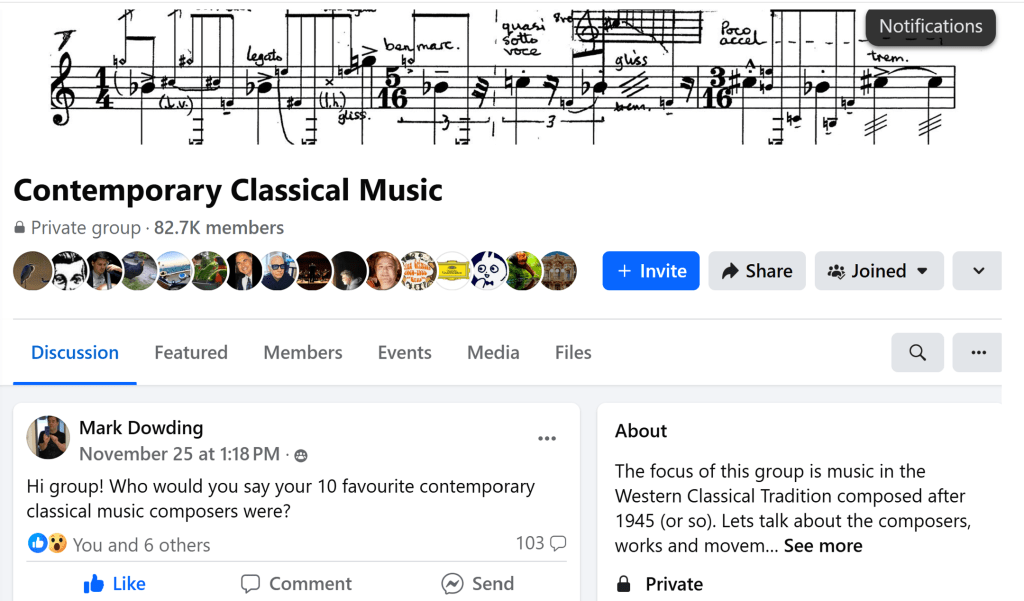
(AI cartoon created by Openart.AI, which steals bazillions of images from artists off of the internet. If for some weird reason I ever make money from the above, I pledge to donate all profits to the NEA, specifically to their visual artists fund. We have to find a more fair way to support artists during this transition to a less-human, and oligarch-owned, AI culture….)
 S.E. Barcus
Leave a comment